Lean Six Sigma gives operations, BI, and continuous improvement professionals a shared language to improve processes, make data meaningful, and drive results that people on the floor can actually feel. It closes the gap between reports and reality by combining disciplined problem-solving with data-driven decision-making, so dashboards become tools for action instead of just scorecards.
From the floor to the data
When you’re working as an operations supervisor in a warehouse that fulfills online orders, you don’t need a dashboard to tell you when things are jammed up. You feel it: lanes backing up at packing, half‑wrapped pallets parked in the aisles, Kanban cards that don’t match what’s really in the racks. The pain from poor standards, confusing signals, or cluttered workstations shows up in your boots long before it shows up in a monthly report.
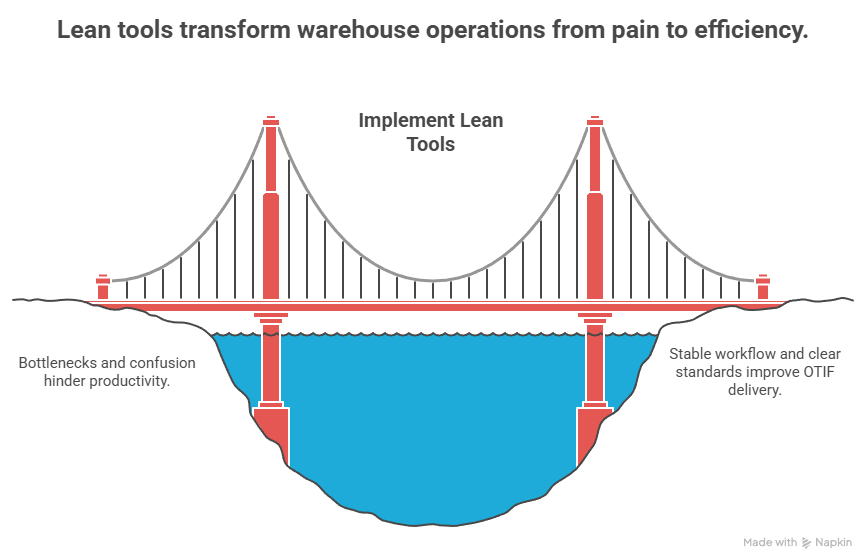
That’s where Lean tools like 5S, Kanban, and standardized work start earning their keep, especially around packing time and on‑time, in‑full (OTIF) delivery. They make waste visible, stabilize the workflow, and provide the team with a standard playbook for how the day should run when things are going right.
Why Lean Six Sigma matters in operations
Lean Six Sigma combines Lean’s focus on eliminating waste with Six Sigma’s focus on reducing variation and defects, wrapped in a structured DMAIC cycle: Define, Measure, Analyze, Improve, and Control. In outbound logistics and warehousing, utilizing tools such as 5S, Kanban, value stream mapping, and standardized work has been demonstrated to enhance productivity, reduce response times, and increase customer satisfaction.
For an operations supervisor, that translates into fewer surprises on the dock, smoother packing support, clearer Kanban signals, and a safer, more organized environment that people actually want to work in. It also creates the discipline and data you need later when you start building BI models and reports that truly reflect how the work flows.
Why it matters just as much in BI
Business intelligence is often treated as a separate island of Power BI models, Excel exports, and SQL queries. Lean Six Sigma pulls BI back into the middle of continuous improvement by making analytics part of the DMAIC cycle instead of an afterthought. The framework aligns naturally with descriptive, diagnostic, predictive, and prescriptive analytics, making it easier to define the right metrics, measure accurately, analyze root causes, test improvements, and control the gains with live KPIs and alerts.
When BI and analytics professionals understand Lean Six Sigma, they design reports that support problem‑solving on the floor, not just pretty dashboards for meetings. That means surfacing bottlenecks, failure modes, and variation in ways supervisors and associates can actually act on during the shift.
Process intelligence: where BI and Lean meet
Modern process intelligence takes this a step further by combining real-time data, process mining, and digital twins with Lean Six Sigma. Instead of static process maps taped to a wall, event logs from WMS, TMS, and production systems can be mined to automatically reveal bottlenecks, waiting time, and rework in picking, packing, and outbound shipping.
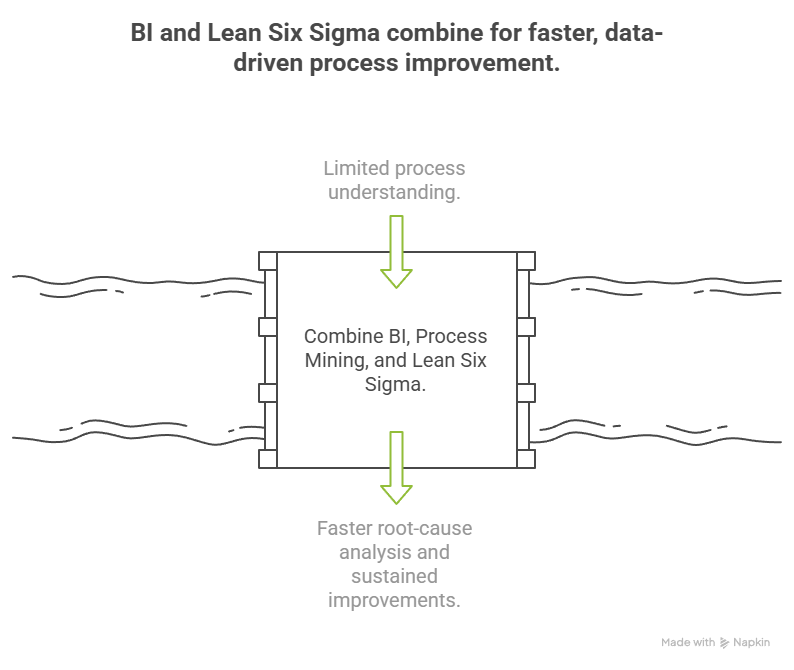
This combination shortens DMAIC project cycles and speeds up root-cause analysis because teams can see how the process actually behaves over thousands of orders, rather than just in a handful of observations. It also helps sustain improvements through automated monitoring and alerts, rather than relying on manual audits that only catch problems after customers have already felt the impact.
Your journey: from CSSC white belt to BI and CI
The Council for Six Sigma Certification (CSSC) uses a belt pathway—white, yellow, green, then black—that lets you build Lean and DMAIC skills one step at a time. At the Yellow Belt level, you learn the language of Lean Six Sigma and how to participate in projects, collect data, and support problem‑solving without having to be the primary project lead yet.
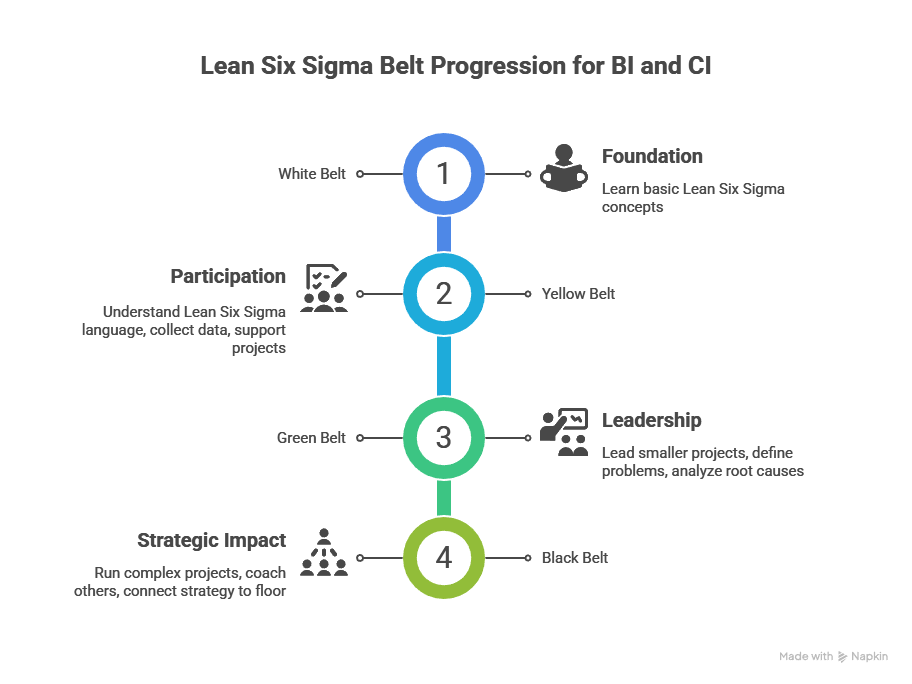
As you progress to Green Belt, you begin leading smaller, well-defined projects in your own area and working more closely with data to define problems, select metrics, and analyze root causes. Black Belts then take that same toolkit and scale it across the business—running complex, cross‑functional projects, coaching Green and Yellow Belts, and acting as change agents who connect executive strategy with what actually happens on the floor.
For someone transitioning from warehouse operations to business intelligence and continuous improvement, the progression from Yellow to Green and eventually Black demonstrates to employers that you understand both the real-world constraints of the floor and the analytical rigor behind solid metrics and reporting. It marks you as somebody who can translate between operators, leaders, and data people without losing the thread.
How BI, CI, and industrial engineering work together
Not everyone on a Lean Six Sigma team has the same destination, and that’s a strength. Industrial engineers, BI developers, and continuous improvement leaders each bring something different to the table. The industrial engineer focuses on line design, capacity, and physical flow. In contrast, the BI and CI side focuses on data pipelines, metrics, and the routines that keep improvements visible and sticky.
In a healthy DMAIC project, the IE may own time studies and work design. At the same time, the BI/CI partner builds dashboards, process intelligence views, and alerts that indicate whether the new design is actually delivering the expected results. That kind of partnership transforms Lean Six Sigma from a one-off project into a living system where engineering changes, cultural shifts, and data all reinforce each other.
Why nontraditional paths (like ops → BI/CI) are so valuable
Organizations are increasingly realizing that some of their strongest BI and continuous improvement leaders began their careers in operations rather than graduating from an industrial engineering program. People who have worked on the floor understand workflows, communication gaps, and the reality of change management in a way you can’t learn from a slide deck.
Lean Six Sigma training provides these cross-functional professionals with a standard toolkit and mindset, enabling them to communicate effectively in both “forklift” and “SQL” contexts with equal respect. It also reinforces a bigger message: career paths do not have to be linear—as long as you keep learning, experimenting, and improving, you can move from stacking boxes to shaping the data and processes that run the whole operation.