TL;DR — Bottom Line Up Front
What this covers: The history of IBM from punch cards to hybrid cloud and AI — and what that 100-year arc teaches operations and analytics professionals about data infrastructure, legacy systems, and why the tools that survive are the ones that adapt.
Who it’s for: Analytics and BI professionals, operations managers exploring data careers, and anyone who wants context on how IBM’s computing history shaped the enterprise data tools they use every day.
Major Innovations and Lessons Learned: What IBM’s History Means for Analytics Professionals
The history of IBM is as much a story of costly mistakes as it is of breakthroughs. The Microsoft deal, which outsourced the PC operating system to Bill Gates and the microprocessor to Intel, handed IBM’s most profitable platform to competitors and cost the company billions through the 1990s. Reliance on mainframe revenue while the market shifted toward business PCs compounded the damage. IBM nearly didn’t survive it.
But the lessons that matter most for operations and analytics professionals aren’t the business school case study mistakes. They’re the quieter ones buried in IBM’s computing history that shaped the tools running in every DC, warehouse, and enterprise today.
IBM Invented the Foundation of Modern Data Work
IBM researchers developed SQL in the 1970s. Every relational database in use today, Oracle, MySQL, PostgreSQL, and SQL Server, runs on that foundation. IBM also invented the hard disk drive, the relational database model, and the mainframe architecture that still processes the majority of the world’s financial transactions. The IBM data analytics history isn’t a history of what IBM sold. It’s a history of what became infrastructure so fundamental that most people forgot IBM built it.
For anyone learning Excel for supply chain analysis or moving into a data analyst or BI role, you are working inside an architecture that IBM built. SQL queries, relational joins, structured data exports from WMS and ERP systems, all of it traces back to decisions IBM made 50 years ago.
Legacy Infrastructure Doesn’t Die, It Becomes the Foundation
The mainframe was supposed to be obsolete by 1990. Then by 2000. Then 2010. IBM Z mainframes still process an estimated 90% of global credit card transactions. The lesson isn’t that mainframes are special. The lesson is that infrastructure embedded deeply enough into critical operations doesn’t get replaced; it gets layers built on top of it.
This is exactly what operations professionals deal with every day. Legacy WMS systems that were supposed to be replaced a decade ago. ERP platforms with 20-year-old data models. Sortation controllers running on hardware nobody stocks parts for anymore. The business intelligence evolution at IBM, from mainframe-only analytics to hybrid cloud and AI running alongside those same mainframes, is a direct parallel to what every serious DC automation project looks like. You don’t rip and replace. You build the analytics layer on top of the existing infrastructure. For a deeper look at how IBM applies this approach internally today, see how IBM’s current analytics and BI stack actually works.
The Hardware-to-Services Pivot Mirrors What Ops Professionals Are Doing Now
In 1991, IBM’s revenue was built on hardware. By 2010, service revenue had grown from $6 billion to $56 billion. IBM didn’t abandon what it knew; it repackaged deep operational expertise into something the market valued more. That pivot is the same one operations professionals make when they move from the floor into analytics and BI roles. The floor experience doesn’t become irrelevant. It becomes the differentiator. The people who understand what the data means because they’ve lived the process it describes are worth more than the people who can only run the query.
IBM Today: How the History of IBM Shapes Its Hybrid Cloud and AI Strategy
To understand where IBM stands today, the history of IBM’s strategic pivots tells you everything you need to know. IBM now delivers a broad portfolio, including software, consulting, infrastructure, and financing. Its two flagship platforms, Watsonx for AI and Red Hat OpenShift for hybrid cloud, position IBM to capitalize on surging demand for these technologies.
Major competitors include Alphabet, Cisco, Microsoft, Amazon, Oracle, Salesforce, and Hewlett-Packard. IBM’s revenue streams include software solutions for data, automation, and security, as well as consulting and infrastructure services. In 2024, under CEO Arvind Krishna, IBM generated $62.8 billion in revenue, invested $7 billion in research, and returned $6 billion to shareholders. For a deeper dive into IBM’s latest financials and leadership strategy, see the IBM 2024 Annual Report.
Krishna emphasizes IBM Research’s mission to invent what’s next across hardware, software, hybrid cloud, AI, and quantum computing, driving value for clients and growth for the company. IBM’s 29 consecutive years of dividend increases and $100 billion in shareholder value from 2022 to 2024 underscore its financial strength and commitment to innovation.
The Role of IT in IBM’s Business Model
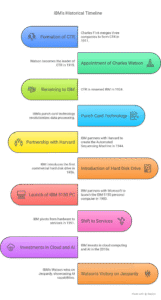
Since its foundation, IBM has placed IT, information, and data at the heart of its business. The 1991 transformation into a service company marked a shift from hardware to IT thought leadership, with significant investments in research and development. IBM’s philosophy is simple: “We sell what we use, and we use what we sell,” a testament to its commitment to leveraging its own technology for client solutions, as explained by IBM executive advisor Louis Labelle.
With over 150,000 patents- 9,130 patents in 2020 alone– IBM remains at the forefront of technological advancement.
IBM’s Impact on Business Operations
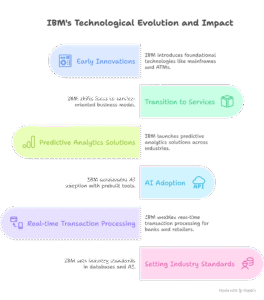
IBM’s innovations have become foundational to modern business operations. IBM’s technologies are deeply embedded in business infrastructure, from mainframes and ATMs to floppy disks, hard drives, magnetic strip cards, relational databases, and SQL development. Its transition to a service-oriented company has also made it a leader in consulting, generating $17.6 billion from these services, as outlined in IBM’s business model analysis.
In 2015, IBM introduced 20 predictive analytics solutions across 12 industries, leveraging data from 50,000 client engagements to deliver out-of-the-box AI and analytics tools. This approach accelerates AI adoption for clients, providing prebuilt dashboards and applications that simplify data-driven decision-making.
IBM’s influence extends from enabling real-time transaction processing for banks and retailers to setting industry standards in databases and AI. Its impact on business and technology is so profound that it’s hard to imagine the modern world without IBM’s contributions.
Major Innovations and Lessons Learned
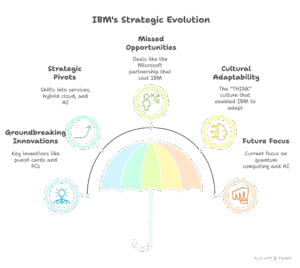
The history of IBM is as much a story of costly mistakes as it is of breakthroughs. IBM’s legacy is marked by groundbreaking innovations: the punch card, mainframe, personal computer, and its strategic pivots into services, hybrid cloud, and AI. However, not all moves have been wins. The Microsoft deal, which sidelined IBM’s OS/2 and outsourced microprocessors to Intel, created the IBM-compatible PC market, costing IBM billions in the 1990s. Reliance on mainframe revenue also hurt as the market shifted toward business PCs.
Yet, IBM’s culture of “THINK” enabled it to adapt, expanding into consulting, hybrid cloud, AI, and quantum computing, ensuring its continued relevance.
The Future: Quantum Computing and Beyond
Looking ahead, IBM is investing heavily in Red Hat Linux for hybrid cloud leadership and Watsonx as its AI flagship, focusing on generative AI and large language models. The company faces fierce competition from Amazon AWS, Microsoft Azure, OpenAI, Google, Anthropic, and Meta in AI.
IBM is also a global leader in quantum computing, with its IBM Quantum Platform and a commitment to developing a quantum-safe world. Through the IBM Quantum Network, it’s building a global ecosystem of businesses, researchers, and universities, ensuring its leadership in this transformative field.
Frequently Asked Questions: History of IBM and Business Intelligence Evolution
Why does the history of IBM matter for analytics professionals today?
Because IBM built the foundation. SQL, the relational database model, the hard disk drive, enterprise mainframe architecture, and the tools analytics professionals use every day trace directly back to IBM research and development decisions made decades ago. Understanding IBM’s computing history is understanding the infrastructure layer on which everything else runs.
What did IBM invent that most directly shaped modern data analytics?
SQL is the most important. Developed by IBM researchers in the 1970s, it became the universal language of relational databases and remains the foundation of enterprise data work today. IBM also pioneered the relational database model itself, the hard disk drive for data storage, and mainframe architectures that still handle the majority of global financial transaction processing.
How did IBM’s business intelligence evolution change enterprise technology?
IBM’s shift from hardware to services in 1991 established the model for enterprise technology consulting, the idea that deep technical expertise packaged as a service is more valuable than the hardware itself. Its later investments in Watson AI, hybrid cloud, and data governance platforms through Watson Knowledge Catalog set the pattern for how large enterprises approach analytics infrastructure today: build governance in, run analytics close to the data, and connect legacy systems to modern tools rather than replacing them.
What can operations professionals learn from IBM’s history of adapting legacy infrastructure?
That legacy systems don’t disappear, they become the foundation layer. IBM Z mainframes still process the majority of the world’s financial transactions, despite being declared obsolete repeatedly over the past 30 years. The analytics strategy IBM uses internally acknowledges this reality: build the modern analytics and AI layer to run alongside existing infrastructure rather than requiring a clean-slate replacement. That is exactly the challenge in DC and warehouse environments, where WMS platforms, ERP systems, and automation controllers from different eras must coexist with modern BI tools.
Is IBM still relevant in the age of AWS and Microsoft Azure?
Yes, in specific domains. IBM’s relevance today is concentrated in industries with heavy mainframe dependency, banking, healthcare, manufacturing, and in enterprises with complex hybrid cloud needs, where Red Hat OpenShift and IBM Cloud Satellite provide value that pure public cloud vendors don’t match. Its WatsonX AI platform is competitive in regulated industries where data governance and on-premises deployment matter more than raw cloud capability.
Conclusion: IBM’s Enduring Relevance in IT
The history of IBM is ultimately a story about reinvention, a company that has never stood still long enough to become irrelevant. Its research investments, strategic pivots, and relentless focus on client value have built a foundation for sustained growth. While competition in cloud and AI is intense, IBM’s leadership in quantum computing positions it for another century of impact.
As management scholars note, the real challenge for today’s leaders is not just understanding technology, but leveraging information systems to drive business strategy and create value. IBM’s ongoing innovations are a testament to this principle, ensuring its influence on the IT industry for years to come.
Explore IBM’s official company history, review the latest annual reports, or discover IBM’s quantum computing initiatives for more insights.