TL;DR — Bottom Line for DC Operators and Supply Chain Students
What this covers: How a distribution center actually works, from the moment a trailer backs into the dock to the moment a pallet rolls out on an outbound truck. Inbound receiving, putaway, slotting, picking, packing, and the KPIs that tell you whether any of it is running right or just looks like it is.
Who it’s for: DC supervisors, operations managers, supply chain students, and anyone who has ever wondered what separates a high-performing distribution center from one that is treading water and calling it good enough.
The short answer: A distribution center is not a warehouse. It is a velocity engine. Goods come in, get positioned for rapid retrieval, and go out. The KPIs that matter are speed, accuracy, and labor cost per unit. If you are not tracking all three, you are managing by feel.
How a distribution center works is one of those questions that sounds simple until you are actually responsible for the answer. A lot of people use “warehouse” and “distribution center” interchangeably. Most of them are wrong, and it costs them.
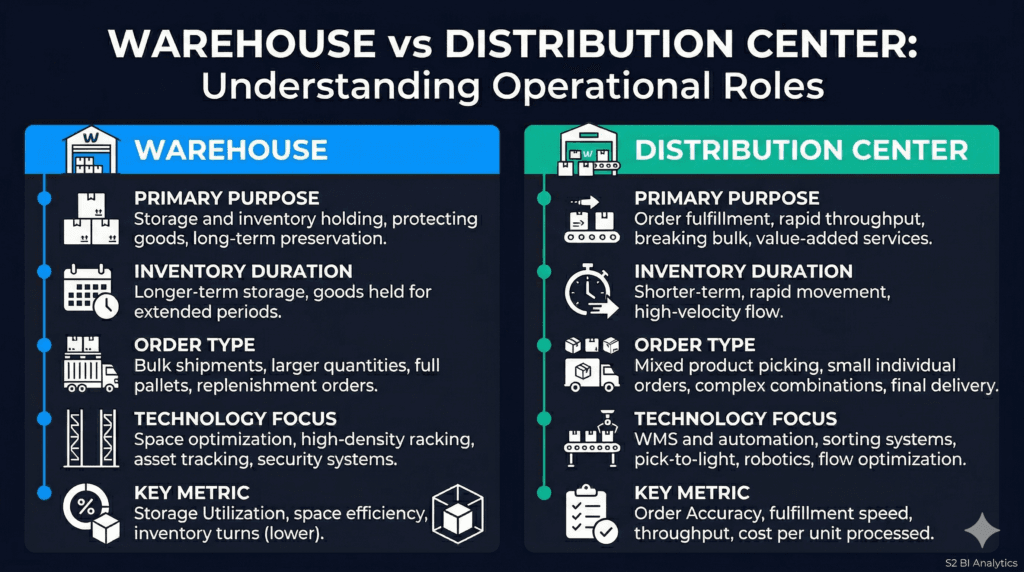
A warehouse stores things. A distribution center moves things. That single difference in purpose drives everything: the technology stack, the labor model, the physical layout, the KPIs you track every shift. Design a DC like a warehouse, manage it like a warehouse, and you will get warehouse results, which in a DC environment means you are failing your downstream customers. Maybe not today. But eventually.
I currently run Packing and Shipping in one of the most highly automated fulfillment centers in the country. Facilities with TGW AS/RS, Vargo COFE sortation, Eurosort systems, and Kindred AI robotic order sorting. High-volume retail replenishment and direct-to-consumer fulfillment both. Here is how a distribution center actually works, and what the numbers look like when it is running right.
Distribution Center Operations Flow
Click any node or KPI for details.

What a Distribution Center Is (and Isn’t)
A distribution center receives goods in bulk from manufacturers or suppliers, positions them for rapid redistribution, and ships them out to retailers, wholesalers, or downstream nodes. The defining characteristic is velocity. Products are not meant to sit. They arrive, get processed, and move.
That is the core difference between distribution centers and warehouses. A warehouse is optimized for storing raw materials or finished goods that might sit for weeks or months before anything moves. A DC is optimized for throughput. Inventory turns are a performance metric, not something you check once a quarter and forget about.
A fulfillment center is a variation on the DC model built for direct-to-consumer orders. Instead of shipping full pallets to a retail store, a fulfillment center picks individual items, packs them into parcel-sized boxes, and ships to residential addresses. Different metrics, different labor model. Picking rates, parcel carrier integration, and pack station efficiency replace the pallet-level throughput measures you track in a traditional DC.
Some facilities do both. Omnichannel retail has pushed many operators into hybrid models, with the same building replenishing stores in the morning and shipping individual consumer orders in the afternoon. That environment. It works, but it requires discipline in keeping the two workflows physically separated. Different KPI profiles, different labor demand patterns. They will fight each other if you let them share space without clear boundaries.
According to the BLS Quarterly Census of Employment and Wages data, the U.S. warehousing and storage industry (NAICS 4931) reported 22,929 private establishments in 4Q 2024. Colliers data reported by Modern Distribution Management indicate that developers added about 1.3 billion square feet of new big-box distribution center and warehouse space (buildings 200,000 square feet and larger) between 2020 and 2024, effectively doubling the big-box market over that period.
The Six Functions of DC Operations
Every DC performs six core functions regardless of size, automation level, or what the org chart looks like. These are workflow stages, not departments, though they often map to departments. Every unit of inventory passes through most or all of them on its way through the building.
1. Inbound Receiving
Before that trailer backs up to the dock, the inventory belongs to the carrier. The moment it hits your dock plate, it is yours. That handoff is receiving, and what happens in the next hour or two sets the tone for everything downstream.
Receiving covers dock door assignment, trailer unloading, quantity verification against the purchase order or advance ship notice (ASN), physical inspection for damage and shortage, and system receiving to log inventory into the WMS. Any exception, overage, shortage, damage, or wrong item gets documented here. If it does not get caught at the dock, it becomes an inventory accuracy problem that is much harder and more expensive to resolve later. I have seen teams chase receiving errors for days because someone on the dock skipped the inspection step during a busy window.
The metric that captures inbound efficiency is dock-to-stock cycle time: the elapsed time from goods arriving at the dock to inventory recorded in the system and available for putaway or picking. I covered the full inbound receiving process in my warehouse receiving post. The short version is that most dock-to-stock problems are process failures, not technology failures. The 2025 WERC DC Measures Report shows best-in-class at under 3.5 hours, which is actually worse than under 3.0 hours in 2024, which WERC flagged as the most significant performance decline among its top-tracked metrics. APQC’s Open Standards Benchmarking data shows a gap of more than 44 hours between top and bottom performers. That is not a rounding error. That is an operational capability gap.
2. Putaway
Putaway moves received goods from the staging area to their assigned storage location. In a WMS-directed environment, the system generates putaway tasks based on item velocity, storage zone logic, cubic capacity, and replenishment triggers. Workers scan and confirm each location move, keeping inventory records accurate in real time.
Bad putaway is a gift that keeps giving, in the worst way. Wrong location means the pick fails. A wrong location recorded in the WMS results in phantom inventory that will not surface until a picker reaches for something that is not there. Both are slow and expensive to untangle.
3. Storage
This is where the product lives until demand triggers a pick. Storage in a DC is not passive holding. The physical arrangement of inventory, which SKUs sit where, how high, how close to the pick face, directly determines how efficient your pick operation will be. Which is why slotting matters.
4. Slotting
Slotting is the deliberate assignment of SKUs to storage locations based on demand frequency, physical characteristics, and pick zone strategy. Most people treat it as a setup task. It is actually one of the highest-leverage variables in the entire labor model, and it drifts constantly if nobody owns it.
Research on pick path efficiency consistently shows that picker travel time accounts for 50 to 57 percent of total pick time, meaning more than half the labor clock is spent walking, not picking. Slotting controls how far pickers travel. Fast-moving SKUs belong in golden zone locations: between knee and shoulder height, closest to the packing area, no bending, no reaching, no extra steps.
The productivity numbers are not subtle. Research on dynamic slotting optimization, including peer-reviewed work presented at Georgia Southern’s material handling research conference, shows significant reductions in pick paths when SKU correlation drives location assignment. Industry benchmarks put the resulting productivity improvement at 5 to 20 percent from well-executed slotting programs. A DC running 500,000 orders annually at a 3 percent error rate is carrying a hard cost exposure of $700,000 to $1.4 million in re-pick and re-ship costs. That figure is illustrative rather than audited, but the directional point holds: slotting decisions compound. Every shift, every week, every quarter.
At every facility where I have managed operations, slotting reviews ran on a defined cycle. SKU velocity data came out of the WMS. When ABC classifications shifted, locations got updated. Teams that treated slotting as a one-time setup paid for it in labor hours they never fully tracked.
5. Picking, Packing, and Shipping
Picking is where most of your labor cost lives, which means it is where most of your problems live too. Labor accounts for 50 to 70 percent of total DC operating costs across the industry, according to F. Curtis Barry and Company’s fulfillment operations research. Picking alone drives 30 to 50 percent of total DC labor costs.
The 2025 Modern Materials Handling automation survey found that 52 percent of DC and warehouse operations are mostly or all manual for order fulfillment, up from 43 percent in 2024. Only 4 percent describe themselves as highly automated, down from 10 percent the year before. There is a significant gap between what the industry says it is investing in and what is actually running on the floor.
Pick methods run from discrete paper picks at the low end to voice-directed, pick-to-light, goods-to-person AS/RS, and robotic picking at the high end. The WERC 2025 DC Measures Report puts best-in-class at 70 lines picked and shipped per hour. Efficient WMS or voice-directed operations regularly hit 100 to 175. ASCM’s benchmark for highly optimized scanning operations goes to 150 to 250.
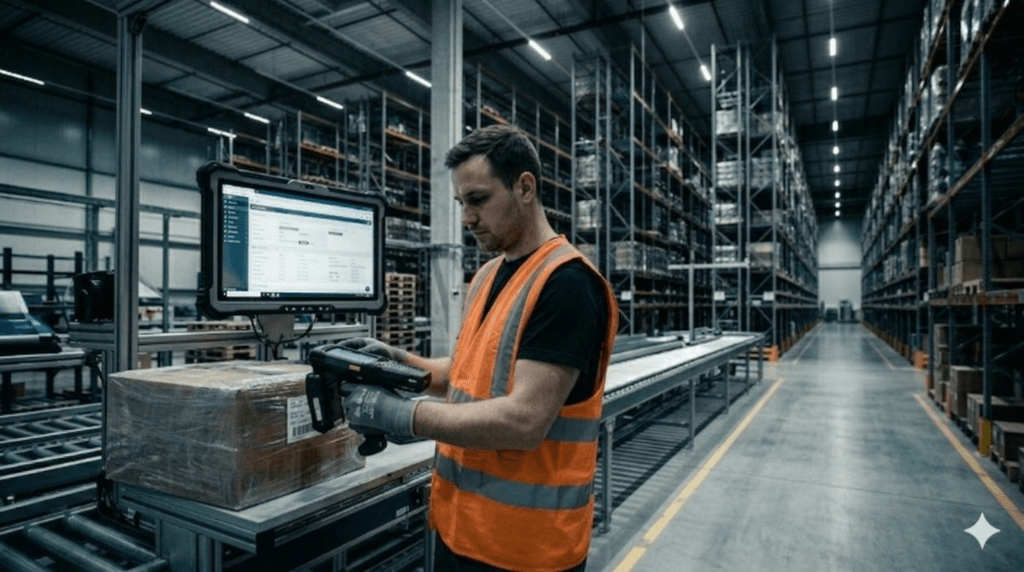
At the Gap distribution center where I work, we use Manhattan WMS and Vargo COFE-directed picking, and automated goods-to-person systems including TGW AS/RS for replenishment and Kindred AI robotic sorting in the packing department. The throughput difference between well-directed manual stocking with ASRS at high volume is not incremental. It is categorical.
After picking comes pack verification, cartonization, labeling, and outbound staging. Packing is where value-added services take place: kitting, retail-compliance labeling, and custom packaging. It is also where many downstream failures are caught before they ship, if the process is tight enough to catch them.
6. Inventory Control
Cycle counting is not something you do when you have time. In a well-managed DC, it runs continuously. The WMS assigns count tasks based on location activity, ABC classification, and time since last count. Full physical inventory at defined intervals validates the perpetual record. If inventory count accuracy by location is not above 99 percent, every downstream function is running on bad data. WERC 2025 puts best-in-class at 99.5 percent or better. Below that, you are guessing.
How Fulfillment Centers Differ: Same Principles, Different Execution
A fulfillment center is a distribution center optimized for direct-to-consumer orders. The six core functions, receiving, putaway, storage, picking, packing, and shipping, are the same. What changes are the unit of measure, the order profile, and how fast accuracy failures become visible.
Unit of Measure
Distribution centers ship pallets and cases. Fulfillment centers ship eaches. A DC might pick 200 lines to fill 15 customer orders, all going to retail stores. A fulfillment center could pick 200 lines to fill 200 individual consumer orders, all going to different residential addresses. That shift from bulk to eaches changes storage density, pick path design, and the cost structure of every labor hour.
Order Profile
DCs handle larger orders with fewer SKUs per order. Fulfillment centers handle smaller orders with higher SKU variability. A typical e-commerce order averages 1.8 to 2.5 items. That drives discrete picking, single-item pack stations, and parcel carrier integration at scale. Wave batching logic that works in a DC breaks down in a fulfillment center because residential delivery windows are tighter and customer expectations for same-day or next-day shipping are non-negotiable.
Accuracy Visibility
In a DC, a picking error might get caught at the receiving dock of a downstream customer three days later. In a fulfillment center, the customer opens the box at home, sees the wrong item, and you are dealing with a return, a refund request, and a service failure review within 24 hours. The feedback loop is immediate. Error rates that a DC can absorb, 97 percent accuracy, and a 3 percent error rate, will destroy a fulfillment operation. You need 99.5 percent or better, and you need it consistently.
KPI Differences
The benchmarks shift. WERC’s 70 lines per hour, best-in-class for DCs, does not directly translate to fulfillment. Parcel volume, pack complexity, and value-added services, gift wrap, custom inserts, and promotional materials, add labor time that pure distribution operations do not carry. Cost per order shipped becomes the primary efficiency metric, not cost per pallet or cost per case. On-time ship rate and perfect order rate drive the customer experience scorecard.
Technology Stack
Fulfillment centers integrate with e-commerce platforms and parcel carriers in real time. The WMS must handle split shipments, backorder logic, and order modifications after release. Pack-and-hold for subscription boxes, kitting for bundled products, and serialized inventory for high-value goods are standard requirements. Most DC-focused WMS platforms struggle with this level of order complexity without significant custom development.
What Stays the Same
The operational discipline does not change. Slotting still drives productivity. Inventory accuracy still determines whether the system can be trusted. Cycle counting still runs daily. Dock-to-stock time still matters because goods sitting in the receiving area are unavailable to fulfill orders. The difference is that inefficiencies show up faster in a fulfillment center because the customer is the final destination, not an intermediary in a longer supply chain.
If you are running a hybrid operation with DC and fulfillment functions in the same building, you already know the tension between these two models. The KPI profiles pull in different directions, labor demand patterns peak at different times, and the technology requirements do not cleanly overlap. Managing both under one roof is doable. It just requires clear operational boundaries and the discipline to maintain them when volume spikes.
The Technology Layer
A distribution center runs on three technology tiers. Most people only think about one of them.
The Warehouse Management System (WMS) is the operational brain. It directs receiving, putaway, replenishment, picking, and shipping through task management logic. The 2025 Modern Materials Handling Automation Solutions Study found that 63 percent of companies currently use a WMS. That sounds like a lot until you flip it: more than a third of operations are running without systematic task direction. The WMS market is projected to grow at a 13-17% CAGR, depending on the source, driven by e-commerce volume and labor cost pressures.
Above the WMS, in fully automated facilities, sits the Warehouse Execution System (WES). The WES coordinates real-time material flow across conveyor, sortation, and robotic systems, the microsecond sequencing decisions a WMS is not built to make. Below the WMS is the Warehouse Control System (WCS), which handles machine-level communication with automated equipment. WMS, WES, WCS. They are not interchangeable terms, and mixing them up in a vendor conversation will cost you credibility.
Automated Storage and Retrieval Systems handle the physical movement of goods to and from storage in high-throughput environments. The TGW AS/RS I have worked with on the floor is not a pilot project or a proof-of-concept. In a high-volume environment with consistent daily throughput, it handles replenishment to forward-pick zones at a pace and accuracy that manual forklift operations simply cannot match, especially during peak.
The MHI/Deloitte 2025 Annual Industry Report found that 55 percent of supply chain leaders are increasing technology investment, with 60 percent planning to spend over $1 million. Robotics and automation are projected to reach 83% adoption within 5 years. Current AI usage in supply chains sits at 28 percent, projected to reach 82 percent by 2029. Whether those timelines hold depends entirely on how quickly integration costs decline and how many implementations actually deliver what was promised.
The KPIs That Tell You How a Distribution Center Works
You can walk a DC floor and feel like things are moving. Product is flowing, people are busy, and trucks are leaving on time. And the operation can still be underperforming by every meaningful measure. The metrics are what tell you what is actually happening.

The WERC DC Measures Report is the closest thing the industry has to an objective benchmark standard. Here is what the 2025 report shows for the metrics that matter most.
Order Picking Accuracy. Best-in-class is 99.68 percent. The industry average for manual operations is 97 to 99 percent. That gap sounds manageable until you do the math. At 500,000 orders, the difference between 97 percent and 99.68 percent is 11,600 orders, in exceptions or failures. ASCM’s benchmark range puts best-in-class at 99.5-99.9 percent, consistent with WERC.
Dock-to-Stock Cycle Time. Best-in-class under 3.5 hours. APQC’s top-quartile performers beat 3.0 hours. Mid-sized operations average 12 to 24 hours. 3PLs can run 48 hours and consider that normal. Inbound velocity determines how fast your inventory is available to fill outbound demand. Slow receiving is slow fulfillment, just with a delay in between.
Total Order Cycle Time. Best-in-class under 6 hours per the 2025 WERC DC Measures Report. WERC defines this as end-to-end time from order placement to customer receipt, excluding non-working days. This worsened from under 4 hours in 2024, and WERC tied the deterioration directly to market volatility. Worth noting: this measures DC-to-downstream-customer handoff, not parcel delivery to a consumer’s door.
Lines Picked and Shipped per Hour. Best-in-class at 70 or higher. Under 50 in a non-automated environment warrants a slotting review and a process observation before you do anything else. Under 35, you have a problem, probably more than one.
Perfect Order Rate. On time, in full, damage-free, correct documentation. The composite score. APQC’s median performer hits 90, indicating that 10 percent of orders experience some form of failure. Top quartile hits 95 or better. The formula: multiply on-time rate by fill rate by damage-free rate by documentation accuracy, then multiply by 100. Run the numbers on your operation. The result will be lower than you expect. It always is.
On-Time Shipments. Best-in-class at 99.5 percent or better. Carrier relationships, dock scheduling, and outbound staging discipline. All three have to work together. Any one of them can drag the number down.
What the Benchmarks Actually Tell You
The 2025 WERC report’s theme was vision and vigilance. That is not a tagline. Several key metrics, dock-to-stock time, total order cycle time, and picking accuracy deteriorated year-over-year. The industry is absorbing labor cost pressure, the complexity of technology implementation, and demand volatility simultaneously. Holding best-in-class performance through that environment is genuinely hard, and the data shows it.
What the numbers do not show is why performance slipped at any specific facility. That part is always the same story. Slotting drifts when nobody reviews it. Labor productivity erodes when turnover outruns training. Inventory accuracy degrades when exception handling gets informal. The benchmarks do not hold themselves. Someone has to own them.
At S2 BI Analytics, I use the WERC DC Measures benchmarks as the reference standard because there is no better one. If your dock-to-stock is sitting at 18 hours and WERC best-in-class is under 3.5, you are not chasing industry leaders. You are chasing a version of your own operation that used to run better. Figure out when it changed and why. That is where the fix is.
Frequently Asked Questions
What is the difference between a distribution center and a warehouse?
A warehouse is optimized for storage, often holding goods for weeks or months. A distribution center is optimized for velocity, receiving products in bulk and redistributing them to downstream customers as fast as the operation allows. The key distinction is throughput versus storage duration. A DC uses WMS-directed workflows, defined pick paths, and performance metrics tied to speed and accuracy. A warehouse’s primary metrics are storage utilization and inventory carrying cost.
What is a good order picking accuracy rate for a distribution center?
Best-in-class is 99.68 percent per the 2025 WERC DC Measures Report. ASCM’s benchmark range puts best-in-class at 99.5-99.9 percent. The industry average for manual picking operations is around 97 percent, with a 1 to 3 percent error rate. Below 98 percent, you have a training, process, or technology gap worth addressing. Below 97 percent, you are losing customers, whether you know it yet or not.
How is DC throughput calculated?
Throughput is total units, orders, or lines processed within a defined time period: total units processed divided by the time period. On the floor, most operators track picks per hour as the primary productivity measure, labor cost per unit as the financial efficiency measure, and dock-to-stock time as the inbound throughput indicator. The WERC benchmark metric is lines picked and shipped per hour, with best-in-class at 70 or better.
How does slotting affect pick productivity?
Picker travel time accounts for 50-75% of total pick time, depending on the facility and pick method. Effective slotting places fast-moving SKUs in accessible golden zone locations near packing stations, directly cutting travel time and improving picks per hour. Research on dynamic slotting shows productivity improvements of 5 to 20 percent from well-executed programs. Poor slotting that drops a 100-picks-per-hour operation to 80 picks per hour creates six-figure annual labor cost increases in any high-volume facility. It is a quiet problem that compounds over time.
What percentage of DC operating costs is labor?
Labor accounts for 50 to 70 percent of total DC operating costs per F. Curtis Barry and Company’s fulfillment operations research. Picking alone drives 30 to 50 percent of total DC labor costs. Average hourly earnings in transportation and warehousing hit $31.52 as of July 2025, per Bureau of Labor Statistics data. Annual sector turnover consistently runs above 40 percent, indicating that training costs and ramp time are not one-time investments. They are permanent line items in your labor budget.
The distribution centers that consistently hit WERC best-in-class benchmarks don’t run on better luck. They run on better data, tighter process discipline, and operational leaders who know the difference between looking busy and actually performing. If your dock-to-stock is sitting at 18 hours and best-in-class is under 3.5, you don’t have a technology problem. You have a process problem. Find it. Fix it. Measure it