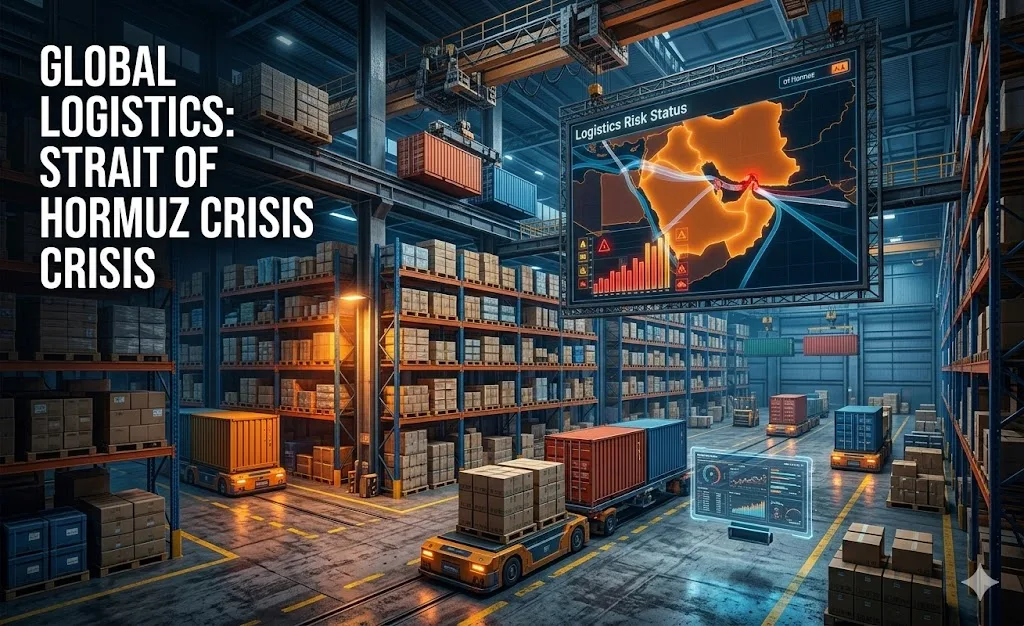
What’s Happening Now: On February 28, 2026, US and Israeli forces struck Iran, triggering the near-complete closure of the Strait of Hormuz. According to UNCTAD’s rapid analysis, vessel traffic fell 97% in the first week of March, from 129 transits per day to just seven.
Kpler vessel-tracking data confirm that approximately 16 million barrels per day of petroleum products have stopped flowing through the strait. This includes roughly 10% of global gasoil trade and 20% of global jet fuel and kerosene flows.
Brent crude crossed $100 per barrel on March 8 for the first time in nearly four years, reaching as high as $126 during the acute phase. S&P Global recorded only a single commercial transit on March 12. This is no longer a disruption on the horizon; it’s already in your supply chain.
The Strait of Hormuz supply chain risk isn’t theoretical anymore. It’s showing up in carrier invoices right now. Your packaging supplier quotes. Your inbound receiving schedule. Doesn’t matter if you source a single SKU from the Middle East or not.
Most of the coverage gets this wrong. It focuses on oil markets and geopolitics, which is fair enough if you’re an energy analyst. But if you’re running a distribution center or managing an operations budget, those aren’t the right questions. What hits your dock? When? And what can you actually do about it?
I’ve spent 25 years in distribution operations. I’ve watched fuel surcharges turn a stable freight budget into a fire drill. Seen carrier contracts unravel because nobody read the force majeure clause. Managed inbound pipelines through disruptions that started as someone else’s problem and ended up on my floor. The mechanisms here aren’t new to me. The scale of this one is.
This post covers the five risk categories DC operators need to track right now, a mitigation framework for each, and the decision triggers that distinguish between acting and monitoring. The geopolitics will resolve on a timeline you don’t control. Your response framework is something you can actually own.
Prefer to listen? The video below walks through the full Strait of Hormuz supply chain risk framework, the five DC operator risk categories, the safety stock formula, and the decision triggers – in about five minutes.
Why the Strait of Hormuz Hits Your DC Even If You Don’t Source from the Middle East
This is the question I hear most often from ops leaders right now: We don’t buy anything from the Middle East, so why should we care? It’s the wrong frame. The Strait doesn’t just move the products you buy. It moves the energy that prices everything you ship, and the feedstocks that go into almost everything you package and sell.
The Energy Transmission Channel
The mechanism is straightforward. Brent crude sat at $73.01 per barrel on February 27, the day before the strikes. By March 8th it had crossed $100. The following week, physical cargo prices for actual barrels traded well above futures benchmarks as Asian and European refiners competed for available supply.
That crude move translates directly into diesel. As of March 17, the national average retail diesel price had risen to $5.044 per gallon, the first crossing above $5.00 since December 2022. The pre-conflict baseline was $3.71 on February 16. That’s a $1.33 increase in 29 days.
Here’s where it lands on your P&L: FedEx and UPS both adjust fuel surcharges weekly based on the EIA’s national diesel average. In a single week, March 9 to March 16, FedEx’s Ground fuel surcharge jumped from 22.25% to 25.00%. Supply Chain Dive confirmed UPS moved its weekly surcharge rate to 22.75% at the $3.85 diesel band, with further increases tracking the weekly EIA publication. These aren’t annual contract renegotiations. They’re weekly repricing events, and they’re not done moving.
For a DC shipping high volumes of parcels or regional LTL, a 2.75 percentage-point surcharge jump in one week is a material budget variance. For wholesale distributors where freight historically runs 2–5% of revenue, this kind of disruption can double that line item before the quarter closes. If you want a grounding on how fuel costs move through each global supply chain transportation mode, that post covers the mechanics in detail.
The Feedstock Channel: Strait of Hormuz Supply Chain Impact

The second channel is slower and less visible. That’s what makes it more dangerous to ignore. The Middle East accounts for approximately 25% of global polypropylene and polyethylene exports, according to S&P Global Platts. Those aren’t finished goods. They’re the raw inputs for plastic packaging film, rigid containers, flexible pouches, and synthetic textiles. The packaging your product ships in. In many cases, the product itself.
Since March 2, European PP prices have risen by EUR 220 per metric ton, and Asian PP prices have risen by USD 330 per metric ton. QatarEnergy declared force majeure on polymer production. Multiple producers suspended loadings. The Food Navigator reports that the “vast majority” of Middle East polyethylene capacity depends on the Strait for waterborne exports.
These cost increases hit your DC through supplier price adjustment clauses, typically with a 4–8 week lag. You won’t see them in this week’s invoice. You’ll see them in next quarter’s COGS, when your packaging supplier invokes the raw material escalation clause you negotiated two years ago in a different cost environment.
5 Critical Strait of Hormuz Supply Chain Risk Categories for DC Operators
Not all exposure is equal, and not all of it hits at the same time. Here’s how to think about each risk category, what the current data shows, and the timeline before it materializes in your operations.
Risk 1: Energy and Fuel Costs
This fuel surcharge distribution center impact is already here: Diesel at $5.044 per gallon, FedEx Ground at 25.00% surcharge, UPS tracking weekly, the cost of moving goods has shifted overnight. This isn’t just an energy headline; it is a direct hit to your outbound freight budget. Kpler quantifies the supply exposure: 10% of global gasoil trade and 20% of global jet fuel and kerosene flows transited Hormuz before the closure. Both categories are now constrained simultaneously.
The key thing to understand about carrier fuel surcharge mechanics is the timing. Both FedEx and UPS use the EIA weekly diesel average, published every Monday, with surcharge adjustments effective the following week. That means a diesel price spike on Wednesday shows up in your carrier invoice ten days later. You have a narrow window between the EIA publication and the invoice to revise your outbound cost assumptions.
Timeline to impact: Already active.
Risk 2: Lead Time Volatility
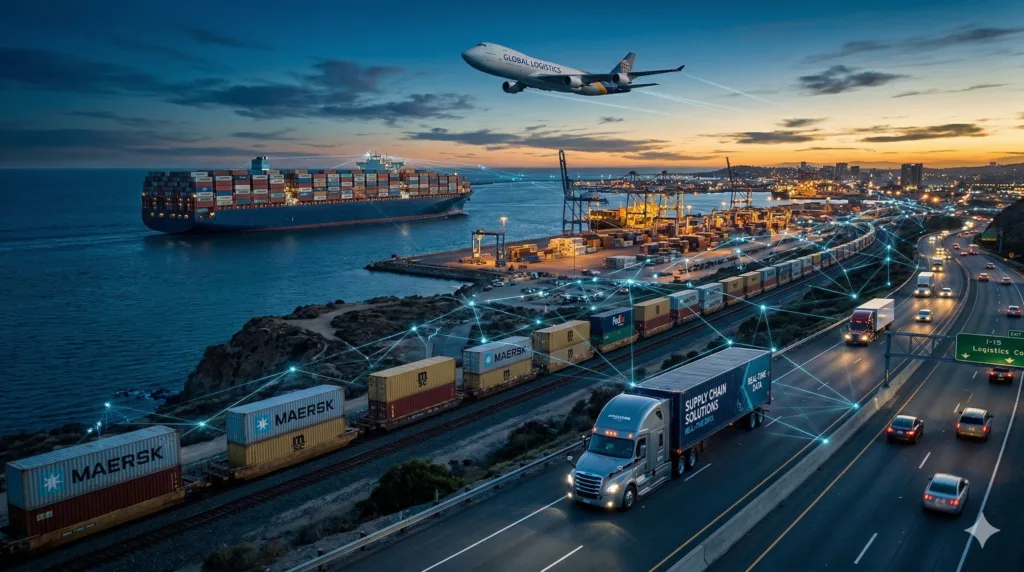
Every major container carrier has rerouted vessels around the Cape of Good Hope to avoid disruption at this maritime chokepoint. Maersk’s ME11/MECL service advisory confirmed up to a 14-day transit time increase on rerouted voyages. Gosships analysis puts the westbound penalty at approximately 19 days compared to Suez routing, with a corresponding 10–15% reduction in annual cargo capacity as vessel cycles lengthen.
The working capital math is worth running. J.P. Morgan’s analysis of the Red Sea disruption found approximately a 30% increase in transit times and a 9% reduction in effective global container capacity. For a company carrying $10 million in average ocean freight inventory, a 19-day extension on a 40-day Asia-US service implies roughly $4.75 million in additional working capital required to maintain the same service level. That’s before any safety stock adjustment.
Jonathan Gold, VP of Supply Chain and Customs Policy at the National Retail Federation, testified before the House Coast Guard and Maritime Transportation Subcommittee during the 2024 Red Sea disruption that retailers were adding “an additional 10 to 14 days of transit time” to their supply chains to accommodate longer routes. That testimony represents the strongest publicly-sourced estimate for the DC lag window — the time between disruption onset and your receiving system first registering missed or delayed inbound shipments.
Timeline to impact: Weeks 2–5 for inbound receiving disruption; longer for normalized carrier schedules.
Risk 3: Freight Surcharges
War risk surcharges went live within 48 hours of the February 28 strikes. Current carrier surcharge levels as of early March 2026:
- Hapag-Lloyd: $1,500/TEU standard; $3,500/TEU for reefer or specialized cargo
- CMA CGM: $2,000–$3,000/TEU; $4,000/TEU for specialized
- Maersk: $1,800 per 20-foot container; $2,400 per 40-foot
- MSC: War risk variable plus $25/TEU/day after 14 days at anchor
UNCTAD confirms war risk insurance premiums that previously cost approximately $250,000 per voyage have risen to as much as $1 million per voyage — a 4x increase. Lloyd’s List reported 10–12 times the war risk premium increasing within 48 hours of the strikes.
For VLCC tanker markets, Kpler data show day rates rose 94% since February 28. General freight rates on affected routes are up approximately 250%. If your carrier contracts were written before March 2026, they weren’t written for this cost environment. Pull the fuel surcharge clauses and force majeure provisions before they come to you.
Timeline to impact: Immediate for new bookings; contract review urgency now.
Risk 4: Inventory Exposure
The categories most exposed aren’t always obvious from a product category perspective. Think about input materials, not finished goods:
- Plastic packaging film, bottles, and flexible packaging (polyethylene)
- Rigid containers and consumer product housings (polypropylene)
- Synthetic apparel and textiles (ethylene glycol-derived polyester)
- Aluminum components and housewares (Qatalum smelter in Qatar, 650,000 tonnes/year output, began phased shutdown)
- Agricultural inputs and products with fertilizer exposure (roughly 30% of globally traded urea and ammonia pass through Hormuz, per UNCTAD)
Kpler’s strandee count puts 984 tankers and gas carriers, approximately 22% of the global fleet, stranded in or near the Middle East region. This isn’t a days-long queue. It’s a weeks-long inventory constraint that will work through the system unevenly, creating alternating scarcity and gluts as vessels eventually clear.
Timeline to impact: Weeks 4–8 for stockout risk on Gulf-routed or feedstock-exposed SKUs.
Risk 5: Supplier Concentration Risk
This is the risk category that’s hardest to see from a distance. Your direct supplier may be in Southeast Asia or Europe. But if that supplier’s raw material inputs trace back to Middle Eastern petrochemical producers, and many do, given the region’s 25% share of global PP/PE exports, you have indirect exposure that won’t show up in your supplier country of origin data.
QatarEnergy’s force majeure declaration halted downstream polymer production. Saudi Arabia’s SABIC explored trucking polymer products overland to Red Sea ports, but market participants characterized it as “technically challenging” and limited in scale. The bypass options for non-oil cargo from the Gulf are even more constrained than they are for crude.
If you don’t know which of your suppliers have Gulf-region feedstock exposure, this week is a good time to ask. Most supplier scorecards don’t capture it. Most ops teams don’t know the answer until someone asks specifically.
Timeline to impact: Variable, depends on supplier inventory positions and contract structures.
Mitigation Framework: What DC Operators Can Actually Control
Managing DC operator supply chain risk requires more than just monitoring the news. I ran LTL operations for Yellow Freight out of Texarkana for a stretch of my career. I’ve seen how simultaneity, when fuel, feedstocks, and lead times move together, can break a standard model. You need a framework that treats these as operational variables, not just geopolitical noise.
If you want to understand how freight moves through a terminal before it ever gets to your dock, the LTL freight terminal post covers that ground.
Fuel surcharges were once a predictable part of the pricing conversation—a gradual mechanism rather than a sudden, simultaneous shock.
What’s different now is the compounding effect. Fuel, feedstocks, and lead times are no longer moving in isolation; they are rising in tandem. This creates a massive impact on the Strait of Hormuz supply chain, with energy costs, freight surcharges, and supplier delays converging at the same time. The mitigation framework must address each of these channels separately to protect your margins.
Recalculate Safety Stock Using Updated Lead Time Variance
The standard safety stock formula for a demand-variability scenario is SS = Z × σD × √L. But that’s not the right formula for a disruption like this. When lead time is the dominant variable — which it is when carriers are rerouting around the Cape of Good Hope — the ISM-recommended formula is:
SS = Z × σL × μD
Where Z is your service level Z-score, σL is the standard deviation of lead time, and μD is the average daily demand. The MIT Operations Management course materials (King, MIT 2.810) explicitly confirm: “If lead time were variable, more safety stock would be required to meet performance goals.”
Here’s what that looks like with real numbers. Assume a 95% service level (Z = 1.65), average daily demand of 100 units, and a pre-disruption lead time standard deviation of 2 days. Pre-disruption safety stock: 1.65 × 2 × 100 = 330 units. Now update σL to 10 days to reflect Cape rerouting variability. Post-disruption safety stock: 1.65 × 10 × 100 = 1,650 units. That’s a 5x increase in the buffer requirement to maintain the same service level.

The decision isn’t about increasing safety stock for exposed SKUs. It’s which SKUs warrant it and how to fund the working capital hit without creating storage and carrying cost problems on the back end. Run that calculation by SKU category before you make blanket decisions, and before finance asks you to justify the inventory position change.
Pull Your Carrier Contracts This Week
Fuel surcharge clauses look different in a $5.00/gallon diesel environment than they did when you signed them. What you’re looking for specifically:
- Surcharge calculation method — index-based weekly vs. quarterly reset. Weekly index-based means you’re fully exposed to every EIA publication. Quarterly resets provide a lag buffer but can lead to a larger catch-up adjustment.
- Force majeure language — does it cover war risk events? Does it allow carriers to suspend service, impose emergency surcharges, or exit volume commitments? Most standard language does.
- Rate adjustment caps or floors — any provisions that limit surcharge exposure during acute disruption periods. Less common in standard carrier contracts, but worth identifying if they exist.
If you’re purchasing on FOB or FCA terms — the most common import Incoterms used by US distribution operations — your organization is responsible for war risk surcharges on the main ocean leg. Under CIF or CIP, the seller nominally pays main carriage costs, but standard CIF insurance uses Institute Cargo Clauses (C), which do not automatically include war risk coverage. That endorsement has to be negotiated explicitly. Check what your current marine cargo policy covers before you assume war risk is included.
Call Your Key Suppliers Now, Not Later
The window for a real conversation about lead times, buffer inventory, and shared risk narrows fast once suppliers start adjusting quote validity windows and raising minimum order quantities. Right now, most suppliers are still in early assessment mode. Two weeks from now, they’ll be in self-preservation mode.
What to ask: What’s your current production status on affected materials? Do you have alternative feedstock suppliers or a raw material bypass supply? What’s your current lead time commitment, and what’s the realistic range? And, critically, what are your Incoterms on current open orders, and does your organization intend to renegotiate them in light of the current insurance environment?
That last question matters because some suppliers will push for Incoterms changes that shift freight and insurance responsibility to the buyer. That’s not inherently a problem, but you want to know it’s happening before it shows up on an invoice, not after.
Build a Scenario Landed Cost Model
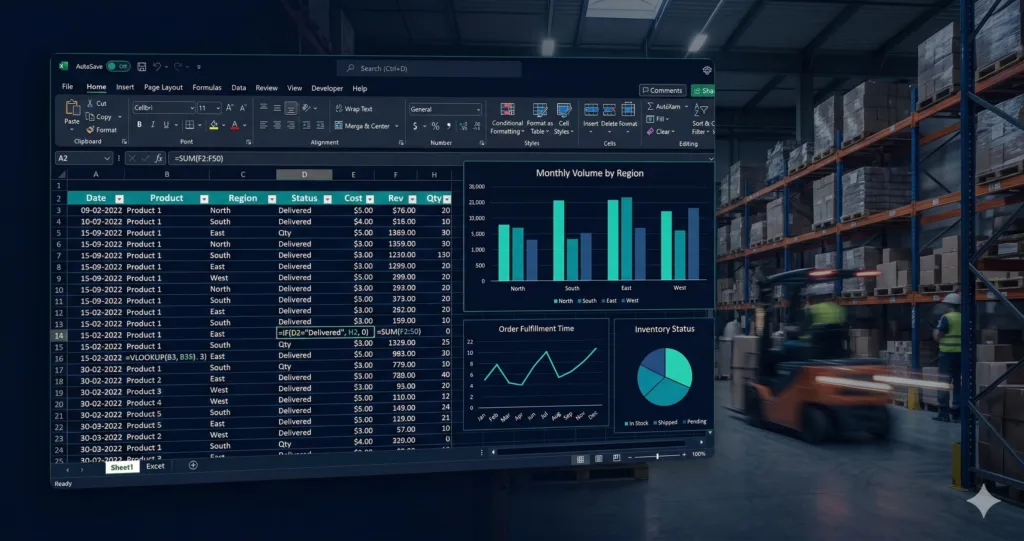
If you can’t model how $110 oil affects your total landed cost by product category, you’re making margin decisions without the full picture. The good news is this doesn’t require a sophisticated BI platform — a well-structured Excel model will do it. At S2 BI Analytics, I’ve written about building this kind of operational decision framework using tools most DC teams already have.
Three scenarios worth building out:
- Short-duration scenario (30 days or less): Oil stays in the $80–95 range. Freight costs are elevated but manageable. The primary action is surcharge monitoring and safety stock adjustments for the most exposed SKU categories.
- Prolonged partial disruption (30–90 days): Oil in the $95–130 range. Feedstock and material costs compound with freight. Safety stock decisions get harder because you’re balancing working capital against genuine supply risk. Carrier relationships and contract flexibility become actual strategic assets.
- Sustained full closure (90+ days): The scenario most planning models don’t include but should. Fitch Ratings chief economist Brian Coulton warned that sustained oil prices above $100 could trigger a $500 billion shock to the global economy, potentially lowering GDP growth by 0.5 percentage points by Q4 2026. At this point, you’re not optimizing operations. You’re doing triage, and the earlier you’ve built the decision framework, the faster you can move.
Decision Triggers: When to Act vs. When to Monitor
ASCM’s 2026 supply chain maturity research put it plainly: “Most organizations are stuck responding to disruptions instead of anticipating them.” MHI CEO John Paxton said it a different way: “2026 marks a turning point where supply chains are not just reacting to disruption, they’re anticipating it.” The practitioners who navigate this better aren’t smarter. They’ve thought through the triggers before the disruption arrived.
Here’s a working framework:

Monitor posture (current baseline): Brent crude $80–100, disruption under 30 days, partial selective passage continuing to develop. Actions: weekly fuel surcharge tracking, carrier contract review, supplier outreach initiated, safety stock recalculation complete for top exposed SKUs.
Active response posture: Brent crude sustained above $100, Cape rerouting confirmed as default for 30+ days, any supplier declaring force majeure or suspending production on feedstock-exposed materials. Actions: scenario landed cost models live, safety stock positions adjusted, Incoterms review complete, alternative sourcing evaluated for highest-risk categories.
Contingency posture: Disruption confirmed beyond 60 days with no credible resolution path, freight cost increases exceeding 40% on affected lanes, and OTIF below the defined threshold for Gulf-routed categories. Actions: carrier diversification, nearshoring evaluation, customer communication on lead time commitments, escalation to finance and executive leadership with quantified scenario modeling.
One useful planning benchmark: the Red Sea disruption had a viable bypass route from day one, and it still showed no full normalization 18 months in. Röhlig Logistics confirmed as late as July 2025 that Cape of Good Hope rerouting remained the default. Hormuz has no comparable bypass for Gulf-originating cargo. The normalization tail here should be planned longer, not shorter. Goldman Sachs adjusted Brent price forecasts three times in the first two weeks alone. A 30-day disruption scenario puts Q4 Brent at $93. The 60-day scenario is higher. Build your planning horizon accordingly.
What You Should Have Done Yesterday (And Can Still Do Today)
The Strait of Hormuz has been a known single point of failure for decades. Supply chain professionals have noted it in risk registers and moved on. What’s different right now is the transition from theoretical to operational. It exposes the gap between organizations that treat geopolitical risk as a planning input and those that treat it as a news headline.
A few things worth doing before the end of this week:
Map your exposure by product category. Which SKUs have meaningful petrochemical, fertilizer, or aluminum content? You probably can’t answer that off the top of your head, and neither can most of your team. That’s the gap. The answer changes what you prioritize in the next 60 days.
Pull your carrier contracts and read the surcharge and force majeure language. Not the summary. The actual clauses. Know what you agreed to before your carrier rep calls you with a surcharge notification you can’t push back on because it’s already in the contract.
Run the safety stock formula on your top 20 exposed SKUs. Even a rough calculation using the ISM lead-time variability formula tells you whether your current inventory position is defensible or whether you’re one delayed vessel away from a stockout conversation with your biggest customer. For a full walkthrough of the calculation with worked examples across multiple disruption scenarios, see How to Calculate Safety Stock During a Supply Chain Disruption .
Call your key suppliers this week — not when their quote windows close. The conversation is easier now than it’ll be in three weeks.
The strait is 21 miles wide. The supply chain impact of a sustained closure is nowhere near proportional to its size. That’s been true for a long time. What’s different right now is that we’re living in the disruption, not modeling it.
If you’re working through the freight cost and inventory implications and want to talk through the analysis, drop a comment below or connect with me on LinkedIn. And if you want to understand how disruptions like this move from the port level into DC receiving and throughput, the port congestion post covers the downstream mechanics in detail.
Frequently Asked Questions
How does the Strait of Hormuz affect US distribution centers?
The Strait of Hormuz affects US distribution centers through two parallel channels: energy costs and feedstock costs. The energy channel is direct. Brent crude above $100 per barrel drives diesel above $5.00 per gallon, which triggers weekly fuel surcharge increases from FedEx and UPS. The feedstock channel is slower but broader. The Middle East accounts for roughly 25% of global polypropylene and polyethylene exports (S&P Global Platts), meaning plastic packaging, flexible film, and rigid containers all face upstream cost pressure even when the finished goods come from domestic or Asian suppliers. US DCs don’t need to source a single product from the region to feel it.
How long does it take for a Hormuz disruption to hit my DC?
Freight surcharges activate immediately. Major carriers imposed war risk surcharges within 48 hours of the February 28 strikes. Diesel-based fuel surcharges are adjusted weekly and appear in carrier invoices 7 to 10 days after the EIA publishes updated prices. Inbound receiving disruptions from delayed or stranded cargo typically materialize in weeks 2 through 5, based on NRF VP Jonathan Gold’s congressional testimony during the Red Sea disruption, which documented retailers adding “an additional 10 to 14 days of transit time” to supply chains. Stockout risk on petrochemical-exposed SKUs builds over weeks 4 through 8 as safety stock depletes against delayed replenishment.
What’s the difference between Hormuz and the Red Sea supply chain risk?
The Red Sea disruption was due to a rerouting issue. Vessels could divert around the Cape of Good Hope, adding 10 to 19 days but maintaining supply continuity. The Hormuz closure is a supply shock with no equivalent bypass. Saudi Arabia’s East-West Pipeline and the UAE’s Habshan-Fujairah pipeline together cover roughly 6 to 8 million barrels per day at maximum utilization, against more than 16 million barrels per day that flowed through the strait before the closure. Iraq, Kuwait, Qatar, and Bahrain have essentially zero alternative export routes. Kpler characterizes the current situation as “de facto closure without a formal blockade,” driven by insurance withdrawal and shipowner decisions rather than a physical blockade.
The Red Sea disruption showed no full normalization after 18 months. Plan Hormuz with a longer tail.
How do I calculate safety stock during a chokepoint disruption?
When lead time variability is the dominant risk, which it is when carriers are rerouting around the Cape, the ISM-recommended formula is: SS = Z × σL × μD, where Z is your service-level Z-score (1.65 for 95%), σL is the standard deviation of lead time in days, and μD is the average daily demand. Using Hormuz-specific inputs: at 95% service level, 100 units/day demand, pre-disruption σL of 2 days versus post-disruption σL of 10 days, safety stock increases from 330 units to 1,650 units.
That’s a 5x buffer requirement to hold the same service level. ISM and MIT Operations Management course materials (King, MIT 2.810) both confirm this formula for lead-time-variable scenarios. Run the calculation by SKU category. The working capital implications are significant, and not every SKU warrants the same response.
What should a DC manager do now that the Strait of Hormuz is closed?
Day 0 to 3: Map which SKUs have exposure to petrochemical feedstocks, Gulf-origin suppliers, or carriers that have suspended Hormuz or Red Sea transits. Do this before the exception report arrives. Days 1 to 7: Pull carrier contracts and review fuel surcharge clauses, force majeure provisions, and war risk coverage terms. Initiate structured outreach to key suppliers to confirm production status, lead time commitments, and bypass supply availability.
Week 1 to 3: Recalculate safety stock using the ISM lead-time variability formula, prioritizing critical, high-velocity, and high-margin SKUs. Weeks 1 to 6: Build scenario landed cost models at three oil price levels before finance asks for them. Weeks 4 to 12: Evaluate Incoterms, carrier diversification, and nearshoring triggers if disruption extends beyond 60 days or freight costs exceed 40% on affected lanes.
S2 BI Analytics covers supply chain operations, warehouse automation, and the data analytics that connect them. Written by someone who’s managed inbound operations through real disruptions, not just read about them.