
TL;DR — Bottom Line for DC Operators
What this covers: How the warehouse receiving process works from trailer arrival to putaway, what dock-to-stock time actually measures, and why the standard reporting method hides the real bottleneck.
Who it’s for: DC supervisors, operations managers, and supply chain practitioners who want to understand why their dock-to-stock number isn’t telling them what they think it is.
Your dock-to-stock number is probably wrong.
Not wrong like you miscalculated it. Wrong, like the thing you’re measuring doesn’t match what you think you’re measuring. Most DCs report dock-to-stock as a single elapsed-time number. What they’re actually reporting is a mix of receiving efficiency, carrier behavior, scheduling gaps, and shift handoff losses, all combined into a single figure that’s almost impossible to act on.
The warehouse receiving process is one of the most consequential workflows in a distribution center. It controls when inventory becomes available for fulfillment. It sets up every downstream operation. And it’s one of the most commonly mismanaged, mostly because the standard metric makes it look like a receiving problem when a chunk of it is actually a wait-time problem.
This post breaks down how the inbound receiving process works, what dock-to-stock time actually measures, and what drives the gap between best-in-class operations and everyone else. If you want to understand how freight gets to your dock in the first place, start with how LTL freight moves through a terminal before it hits your dock.
What Is the Warehouse Receiving Process?
The warehouse receiving process is the sequence of steps that converts an inbound shipment into available, verified inventory in your WMS. It starts when a trailer backs into a dock door and ends when the product is confirmed put away and available for picking.
Those steps, in order:
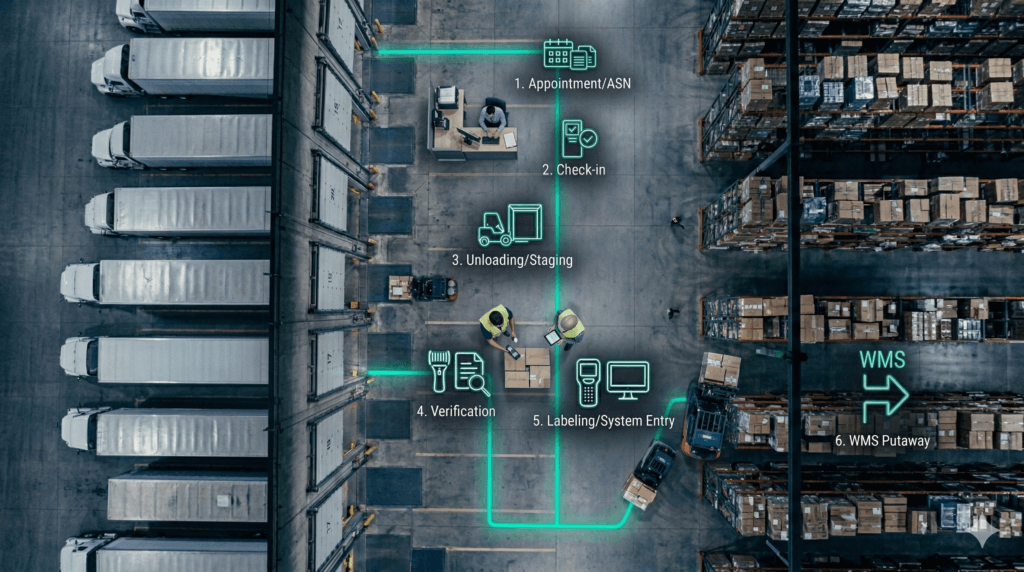
1. Appointment scheduling and pre-arrival planning
Before the truck rolls in, a well-run operation already knows what’s on it. An advance ship notice (ASN), transmitted via EDI 856 by the vendor before the shipment departs, gives your team the PO number, item numbers, carton count, and expected arrival window. That pre-arrival data is what allows you to pre-assign dock doors, pre-position storage locations in the WMS, and schedule the right labor volume.
Without an ASN, your receiver is doing discovery work instead of confirmation work. That’s a meaningfully different job.
2. Trailer check-in and door assignment
The driver presents a bill of lading (BOL), and the load gets assigned to a dock door. This step sounds simple. It rarely is. If appointment scheduling is overbooked, trucks queue in the yard. The clock on dock-to-stock is already running. The product isn’t moving yet.
3. Unloading and staging
The load is offloaded from the trailer and lands in the staging area. Product is sorted, oriented, and staged for counting or putaway. For floor-loaded trailers, this step is labor-intensive and slow. For palletized shipments with compliant SSCC labels, it can move fast. The difference matters a lot at volume.
4. Inspection and verification
This is where the PO gets reconciled against what physically arrived. In a WMS-directed environment with accurate ASNs, this is largely confirmation work: scan the SSCC label, match it to the ASN, and flag exceptions. In a paper-based or blind receiving environment, it’s manual counting and reconciliation. That’s where errors accumulate, and the receiving accuracy rate starts to slide.
5. Labeling and system entry
Any product that arrives without a compliant WMS license plate number (LPN) needs to be labeled here. This is also where non-compliant shipments generate rework. If a vendor skipped the carton barcode requirement, somebody on your dock is printing and applying labels that should have been on the product before it left the supplier’s facility. That labor cost is significant and it’s on you.
6. Putaway
WMS-directed putaway assigns each pallet or carton to a specific storage location based on velocity, product class, and slotting logic. The receiver scans the product, scans the location, and the system confirms the move. That timestamp, the moment the putaway scan clears, is when dock-to-stock stops.
What Dock-to-Stock Time Actually Measures
Here’s the part most operations miss.
APQC defines dock-to-stock cycle time as the elapsed time between goods arriving at the dock and goods being recorded as available in inventory, explicitly including “both time spent actually performing the process and time spent waiting to move forward.” That waiting component is the variable nobody talks about.
The 2025 WERC DC Measures Report puts best-in-class dock-to-stock at under 3.5 hours. A practitioner benchmark from F. Curtis Barry & Company puts it at 8-10 hours for high-performing operations, with midsize companies running 12-24 hours, and 3PLs handling complex requirements pushing up to 48 hours. APQC data shows a 44.1-hour spread between top and bottom performers on this metric.
That spread is not all about receiving efficiency. A meaningful chunk of it is wait time.
Inbound Receiving Process: Processing vs. Wait Time
The clock runs from the moment the trailer arrives. Not from when you start unloading. Not from when the ASN hits your system. Truck arrives, clock starts.
FMCSA data from 2021 puts the average fleet dwell time at 1 hour 54 minutes per stop. For refrigerated carriers, it’s 3 hours 16 minutes. A 2019 pilot study conducted by the Consumer Brands Association and FourKites across six companies, including Coca-Cola and Land O’Lakes, found that median FTL dwell time was 2.6 hours and that dwell times were significantly higher on weekends, when facility staffing dropped.
Think about what that means for your dock-to-stock number. If the average truck is sitting at your door for 90 minutes before a receiver touches it, you’re starting the clock on a 90-minute handicap before you do a single productive thing. That’s not a receiving problem. That’s a scheduling and staffing problem. But it shows up in your dock-to-stock metric as if it’s the same thing.
The same distortion happens at shift boundaries. Product sitting in staging at a shift handoff may not move for an hour or more after the clock ticks over. That idle time shows up in your aggregate dock-to-stock number with zero visibility into what caused it.
If you’re measuring dock-to-stock as a single number, you’re averaging together carrier behavior, shift productivity gaps, scheduling decisions, and receiving efficiency. The only way to diagnose the real problem is to break the metric apart by shift, day of week, supplier, and receipt type. Disruptions that affect your inbound lead times, such as Strait of Hormuz shipping disruptions or port congestion, compound this problem by creating unpredictable arrival windows that make it almost impossible to hold appointments.
The Hidden Cost of Vendor Non-Compliance

I’ve seen what vendor non-compliance does to a receiving dock firsthand, and it’s one of the fastest ways to blow up your dock-to-stock time in ways that are genuinely difficult to control.
Here’s what happens. A trailer arrives without compliant carton labels, labels in the wrong format, or with an ASN that doesn’t match what’s on the truck. The receiver can’t do WMS-directed putaway on that freight. They have to stop, flag the exception, wait for the buyer to reach the vendor, print substitute labels, manually recount, and re-enter the receipt. All of that labor is on the DC, and none of it was in your staffing plan.
The business case numbers are significant. Walmart’s OTIF (On-Time In-Full) program requires 98% supplier compliance and penalizes non-compliant shipments up to 3% of invoice value. Amazon imposes ASN-related chargebacks from 1-6% of product cost, depending on violation type. For a mid-size supplier shipping $50 million annually, a 2% aggregate chargeback rate represents $1 million in margin erosion.
But here’s what the chargeback conversation misses on the DC side: the labor and throughput costs of receiving non-compliant freight rarely appear in the analysis. It disappears into the same dock-to-stock aggregate that makes it look like a receiving problem.
The fix is a vendor compliance program with teeth: specific labeling requirements, ASN accuracy standards with measurable targets, and penalties for deviation that make compliance the cheaper option. The 2024 PRG/Modern Materials Handling Warehouse Survey found that 93% of DCs now use some type of WMS. That technology investment is only as good as the data it receives from your vendors.
Improving Your Receiving Accuracy Rate Through Better Analytics
Dock-to-stock as a single daily average is almost useless for root cause analysis. Here’s how to make it useful.
Segment by receipt type. ASN-enabled receipts versus blind receiving should never be averaged together. The time difference is documented to be 30-50% in most practitioner benchmarks. If you’re mixing them, your number is meaningless.
Segment by shift. If your dock-to-stock spikes on first shift every morning, you have a shift-start productivity problem. If it spikes on weekends, you have a staffing alignment problem. Both look the same in aggregate.
Segment by supplier. If one vendor is driving 40% of your exception receiving volume, that’s a conversation to have with procurement. Your dock-to-stock metric should surface that clearly.
Track processing time separately from dwell time. This requires capturing the truck arrival timestamp separately from the unloading start timestamp. Most WMS systems don’t automatically capture truck arrivals. You may need a yard management system or a manual check-in log to get that first timestamp. It’s worth it. Without it, you can’t separate carrier behavior from DC performance.
At S2 BI Analytics, I write about the gap between the data operations teams collect and the insights they actually use. Dock-to-stock is a perfect example: it’s a metric most DCs report, few decompose, and almost none use to drive targeted improvement.
The formula itself is straightforward: the sum of cycle time across all receipts in the period divided by the total receipts. Use median, not mean, to avoid distortion from outlier loads. But the formula is the easy part. The hard part is understanding what’s inside the number.
Frequently Asked Questions
What is a good dock-to-stock time?
Best-in-class is under 3.5 hours according to the 2025 WERC DC Measures Report. F. Curtis Barry & Company puts high-performing practitioner operations at 8-10 hours, midsize companies at 12-24 hours, and 3PLs handling complex requirements at up to 48 hours. Consistently exceeding 6-8 hours in a standard DC generally signals inefficiencies in receiving, staging, or vendor data quality. Operations with mandatory QA inspection steps, including food and pharmaceutical facilities, will run longer and should calibrate to operation-specific targets rather than cross-industry averages.
How do you calculate dock-to-stock time?
The standard formula: sum of the cycle time in hours for all receipts in the period, divided by total receipts. Use the median rather than the mean to avoid outlier loads skewing the result. The clock starts when the trailer arrives at the dock door, not when unloading begins. The clock stops when the putaway scan clears in your WMS and the product is available for picking. APQC’s definition explicitly includes wait time in that window, which is the most accurate version of the metric.
What causes receiving delays in a warehouse?
The causes split into two categories. Wait-side causes inflate the clock before processing starts: overbooked dock appointments, carrier dwell time, weekend staffing gaps, and shift handoff periods. Processing-side causes are inefficiencies in the actual receiving workflow: missing or inaccurate ASNs, vendor non-compliance requiring exception handling, paper-based processes without WMS direction, and poor putaway logic. Most operations focus exclusively on processing-side causes. Wait-side causes can account for as much time, or more.
Does an ASN really make that much difference to receiving speed?
Yes. When your receiver scans against a pre-loaded ASN rather than counting and manually entering a paper packing list, the receiving workflow becomes confirmation work rather than discovery work. Dock doors can be pre-assigned, labor can be pre-planned, and storage locations can be pre-allocated. The catch is that ASN accuracy must be high for this to work. Target accuracy is 99.5% line-level match to the physical shipment. Inaccurate ASNs create an exception receiving that requires both ASN reconciliation and physical verification simultaneously, which is slower than blind receiving.
What is vendor compliance in warehousing?
Vendor compliance is the set of requirements a DC operator or retailer places on suppliers governing how goods must be shipped, labeled, packaged, and documented. It’s typically specified in a routing guide. Requirements cover labeling standards such as UCC/GS1 barcodes and SSCC labels, ASN transmission requirements, delivery window adherence, and packaging and palletization specs. Non-compliant shipments require exception receiving, which adds labor, inflates dock-to-stock time, and costs throughput capacity that wasn’t budgeted. Retailers recover their costs through chargebacks. Your DC absorbs the cost of labor and reduced throughput.
Bottom Line
Dock-to-stock time is a useful metric when you know what’s inside it. Reported as a single daily average, it tells you how long receiving takes. Broken apart by receipt type, shift, supplier, and dwell component, it tells you why.
Most operations collect this number. Fewer actually use it to drive improvement. The benchmark gap between best-in-class and median performance isn’t mostly about technology or headcount. It’s about whether you’re managing the process you think you’re managing.
If your dock-to-stock is running higher than you’d like, the first question isn’t “how do I speed up my receivers?” It’s “how much of this number is actually receiving, and how much is wait time I’ve been misattributing to the wrong part of the operation?”
That distinction is where the improvement starts.