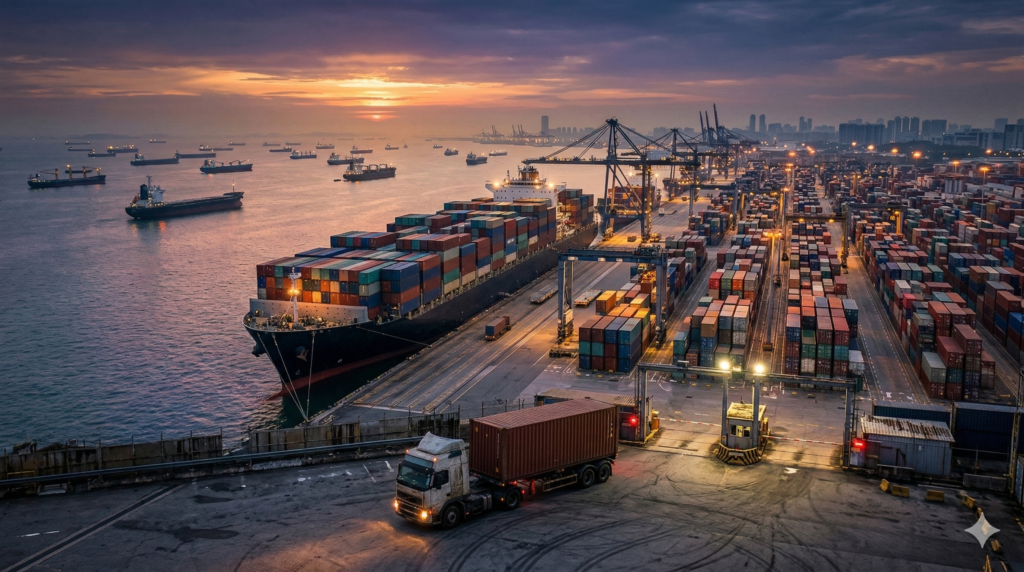
Port congestion makes the news when ships stack up in San Pedro Bay. What doesn’t make the news is what happens 2,000 miles inland when those ships finally start moving again.
That’s where the real cost lives. The port congestion impact on distribution centers is rarely covered, but it shows up hard inside the four walls of a facility, as they try to absorb a week’s worth of delayed freight in a single Tuesday.
Port Congestion Impact on Distribution Centers: The Hidden Costs
Let’s start with what this actually costs, because the scale tends to surprise people who haven’t lived through a congestion event.
The nine largest ocean carriers charged approximately $8.9 billion in demurrage and detention fees, collecting roughly $6.9 billion of that. U.S. ports rank highest globally for D&D charges, averaging $2,008 per container per day as recently as 2023. Standard demurrage rates run $75–$300 per container per day the moment free time expires, with congestion surcharges stacking on top: $200 for 24–48 hours of delay, $500 for 48–72 hours, and $1,000+ beyond 72 hours.
That’s just the port-side bill. The DC hasn’t even entered the picture yet, but the port congestion impact on distribution centers is already accumulating in the form of pending arrivals
Ocean freight rates themselves surged by more than 300% during the disruption. Spot prices from China to the U.S. East Coast hit $17,000 per 40-foot container in mid-2021, against pre-pandemic baselines that seem almost quaint in retrospect. Companies that ran out of inventory options shifted to air freight, which costs 5–10x more per kilogram than ocean freight. When your alternative to waiting is air freight, the math gets painful fast.
Inventory carrying costs, typically 20–30% of total inventory value annually, crept toward 30–40% post-2021 as interest rates climbed and excess stock from delayed, then bunched, shipments piled up in DCs that weren’t sized for the overflow. Capital stuck in in-transit inventory doesn’t earn a return. It borrows against one.
What Port Congestion Actually Is
To address the port congestion impact on distribution centers, you first need to identify whether the bottleneck is at the berth or the gate. Before we trace the ripple downstream, it helps to understand what’s happening at the port, because it’s not just “too many ships.”
Four things tend to go wrong at once at the terminal, and each one amplifies the port congestion impact on distribution centers once that freight finally hits the road.
Vessel bunching is the trigger. When ocean carriers skip ports or blank sailings to manage capacity, weeks of normal freight volume compress into a single arrival window. Pre-pandemic, bunching on the Asia–North America West Coast trade lane ran at 5–15% of capacity. During 2024–2025, that figure hit 20–25%. The Red Sea crisis in 2024 pushed Asia–North Europe routes back to pandemic peak levels. The total cargo volume over a two-week window might be identical to a normal two weeks, it’s just arriving in 48 hours instead of 14 days. Terminals aren’t built for that.
Terminal capacity constraints convert the bunching problem into a dwell-time problem. When yard space fills up, containers can’t move out because there’s no room to stage them. Gates back up. Throughput slows. Global schedule reliability sat at 65–67% in mid-2025, an improvement over the crisis years, but still well below the pre-pandemic norm of roughly 78%. When only two-thirds of ships are arriving on time, your planning assumptions are wrong by default.
Chassis shortages are the part that people underestimate. Containers cannot leave the port without a chassis, the wheeled trailer that carries the container on the road. When chassis aren’t available, drivers wait. Freight sits. Costs compound. This isn’t a COVID-era problem that resolved itself; European hinterland chassis shortages were still causing delays at Antwerp, Hamburg, and Rotterdam as recently as January 2026.
Drayage bottlenecks close the loop. The U.S. trucking industry runs a structural driver gap of 60,000–80,000 drivers. Port drayage is a specialized subset; drivers need TWIC cards, hazmat certifications, and local port knowledge. During severe congestion, a drayage driver might complete two port moves in a day instead of the typical four. Dwell times at the Port of LA averaged 3–4 days in 2025, stretching to 4–8 days at Long Beach depending on terminal and shift schedules.
Now take all four of those failures and watch them move downstream.
The Cascade: Port Congestion Impact on Distribution Centers Explained
If you’ve read the global supply chain transportation modes guide on this site, you already know the journey a container takes from Asia to a U.S. distribution center. Six legs. Multiple handoffs. Each one is a potential failure point. Port congestion doesn’t just slow down leg one or two; it destabilizes everything that comes after.
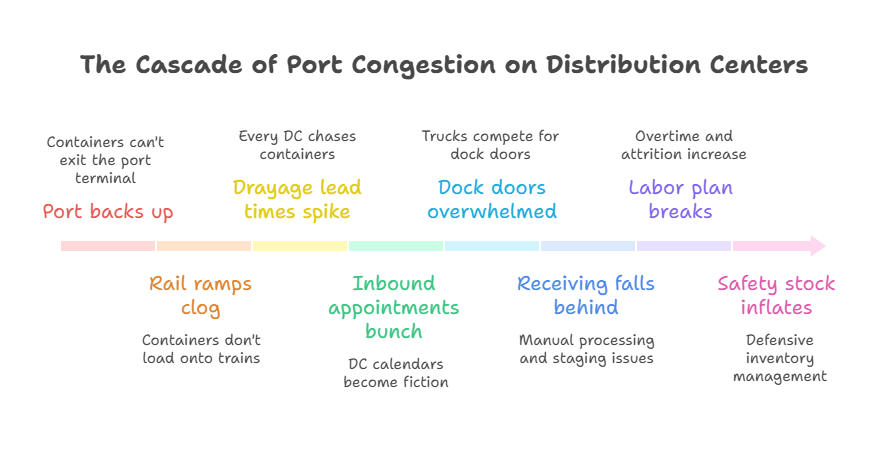
Here’s how the port congestion impact on distribution centers actually cascades through the supply chain:
Port backs up → Rail ramps clog. Containers that can’t exit the port terminal don’t load onto trains. Rail ramp utilization compresses when vessel arrivals spike, and the ramp becomes a secondary staging area for freight that should have moved days ago. The IPI (Inland Point Intermodal) move that normally takes 2–3 days from LA to Chicago? Add buffer time you can’t confidently predict.
Rail ramps clog → Drayage lead times spike. When containers are finally available for pickup, every DC in the region is simultaneously chasing them. Drayage capacity that was idle during the quiet period is suddenly overwhelmed. Appointment windows disappear. Carriers prioritize their best customers. Everyone else waits.
Drayage lead times spike → Inbound appointments bunch. This drayage scarcity is a primary driver of the port congestion impact on distribution centers. This is where the DC starts feeling it directly. A week’s worth of containers that should have arrived over five days show up in two days. Appointment calendars that were built on forecasted arrivals, and those forecasts were already imprecise, become works of fiction.
Inbound appointments bunch → Dock doors get overwhelmed. Without scheduling guardrails, you get appointment clustering: multiple trucks arriving in the same window, competing for the same dock doors, yard space, and receiving staff. Trucks sit in the lot waiting. Detention clocks run. Drivers who have other stops to make leave, which means rescheduled appointments and more disruption tomorrow.
Dock doors overwhelmed → Receiving falls behind. Teams open trailers manually to confirm contents when PO-to-trailer traceability breaks down. Items appear “available” in the WMS but sit staged incorrectly in the receiving area. Putaway stalls because the floor is congested. The receiving area becomes the bottleneck for everything downstream, including replenishment, picking, packing, and outbound.
Receiving behind → Labor plan breaks. This is where the cost compounds hardest. Labor represents 45–57% of total warehouse operating expenses. Healthy overtime should account for no more than 10–15% of total labor expenses. Port-driven surges routinely push facilities past that threshold. Average receiving labor runs around $40.79/hour (total cost). Add overtime premiums and productivity degradation, and the per-unit receiving cost climbs fast. Research consistently shows a 10–30% productivity discount on consecutive overtime shifts. The warehouse industry already runs 53% annual turnover in transportation and warehousing roles; schedule unpredictability accelerates attrition.
Labor plan breaks → Safety stock inflates. When you can’t trust inbound ETAs, you plan defensively. This is a fundamental failure of inventory management caused by external volatility. Safety stock buffers grow to cover the variability your visibility tools can’t resolve. Excess inventory reduces picking efficiency, increases cycle-count complexity, creates safety risks due to crowded rack conditions, and locks up working capital. Inventory carrying costs of 30–40% annually on excess stock aren’t theoretical; they show up directly in return on assets and borrowing requirements.
The peak of this cascade? October 2021 in San Pedro Bay: 73 container ships simultaneously at anchor or drifting. 36 forced to drift because anchorages were full. Average wait time to berth: 9 days. $238 billion in cargo was delayed outside the Port of LA alone between January and November 2021. The “standing inventory” of delayed cargo globally, freight sitting idle because ships couldn’t berth, hit 1.8 million TEU. Pre-pandemic baseline: 260,000 TEU.
That’s a 7x increase in idle freight. Every one of those containers represented a DC somewhere waiting on an inbound that wasn’t coming.
What Good BI Looks Like: Solving Supply Chain Visibility
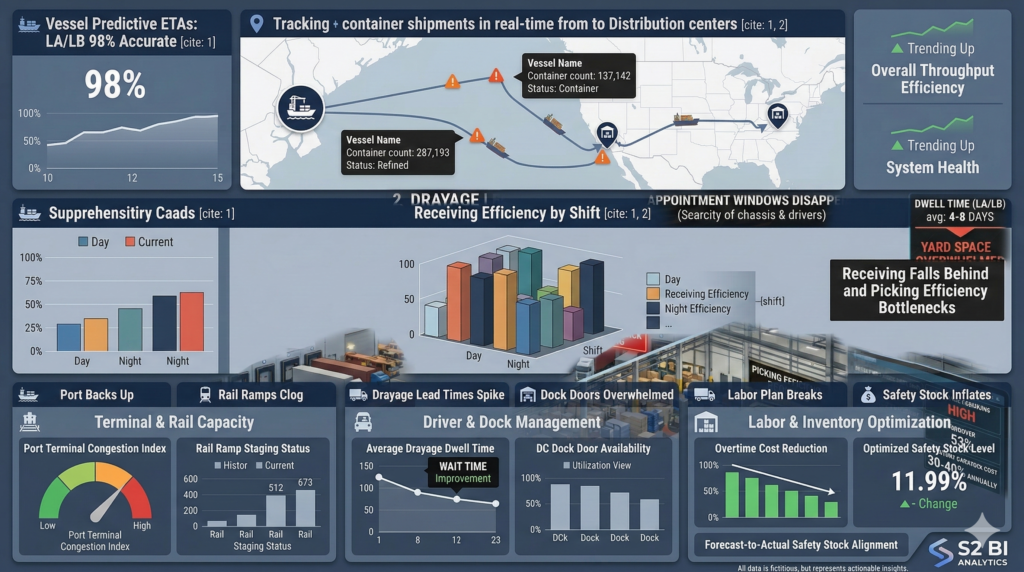
Understanding the port congestion impact on distribution centers is step one; building BI systems that let you see it coming is step two. The visibility gap identified in the transportation modes, post, the gap between where a shipment is and where the system thinks it is, isn’t just an operational nuisance. During a congestion event, it’s a planning crisis. You can’t staff for what you can’t see coming. Data is the only real weapon against the port congestion impact on distribution centers.
The BI plays that actually move the needle here fall into three buckets.
Predictive ETAs that outperform carrier data. Carrier-provided ETAs during congestion events are often wrong in ways that make planning harder, not easier. Portcast’s predictive ETA models, trained on historical voyage data rather than static assumptions, have demonstrated 30% more accuracy than carrier estimates, even 2–4 weeks ahead of arrival.
These models surface the specific reason for the delay (port congestion vs. weather vs. routing deviation), which matters for how you respond operationally. True supply chain visibility isn’t just knowing where the ship is; it’s knowing how that ship’s delay impacts your Tuesday labor plan.
For instance, knowing a vessel is delayed by port congestion in Long Beach is a different planning problem than a typhoon off Japan. The former helps you quantify the eventual port congestion impact on distribution centers and adjust labor shifts accordingly.
Multi-modal visibility platforms that consolidate the picture. Consolidating real-time data from multiple modes allows the DC to stop guessing and start planning. FourKites processes 150 factors, including weather, traffic, GPS, ELD, and AIS data, across truckload, LTL, ocean, rail, and parcel. Project44 covers global multi-modal tracking with order-level visibility and exception management. Both integrate with existing TMS and ERP systems. The key distinction: individual carrier portals tell you where your shipment is on that carrier’s network. They don’t consolidate visibility across all carriers and modes in your inbound pipeline into a single operational view. That consolidation is where BI earns its keep during a disruption.
Carrier scorecards that inform procurement, not just performance reviews. We need to measure variability in transit time across lanes to identify hidden costs. 84% of carriers now consider scorecards a useful performance improvement tool, up from 77% in 2022. The KPIs that matter most aren’t just on-time delivery; they’re transit-time consistency (standard deviation matters as much as the average), dwell time at specific terminals, and lead-time variability by lane. That data feeds directly into RFP decisions and contract negotiations. The carrier that looks cheap on rate but adds two days of variability to every inbound lane is costing you more than the rate difference in labor and carrying costs.
Inbound smoothing dashboards. Dock scheduling software that pulls historical port dwell times, carrier ETAs, gate arrivals, and dock utilization by shift can identify high-risk windows before they become dock crises, specific days, specific lanes, specific terminals where volumes historically spike. Dynamic scheduling reassigns missed slots, notifies yard teams in real time, and gives operations managers something better than gut feel to work with when the phone starts ringing with delayed deliveries.
The Connection to DC Operations
While the port congestion impact on distribution centers is felt most in headcount and overtime, it ultimately dictates your bottom-line agility. The two are the same problem, just viewed from different ends of the pipeline. Ultimately, mitigating the impact of port congestion on distribution centers is about protecting your operational efficiency.
The next post in this series goes inside the DC itself, inbound processing, dock scheduling, labor planning, and how transportation data should be driving those decisions from the moment a vessel departs Asia to the moment a container clears the receiving dock. Master the port congestion impact on distribution centers today to stay ahead of the next global disruption. (Coming soon: “How a Distribution Center Works”)
For a foundational framework on how freight moves across all modes before it ever reaches the port, start with the complete guide to global supply chain transportation modes.
S2 BI Analytics covers supply chain operations, warehouse automation, and the data analytics that connect them. Written by someone who’s managed inbound operations through real disruptions, not just read about them.