The freight terminal post covered how LTL shipments move through the hub-and-spoke network: they are sorted, consolidated, loaded, and dispatched on a city delivery run. That’s where the carrier’s story ends.
This is where yours begins.
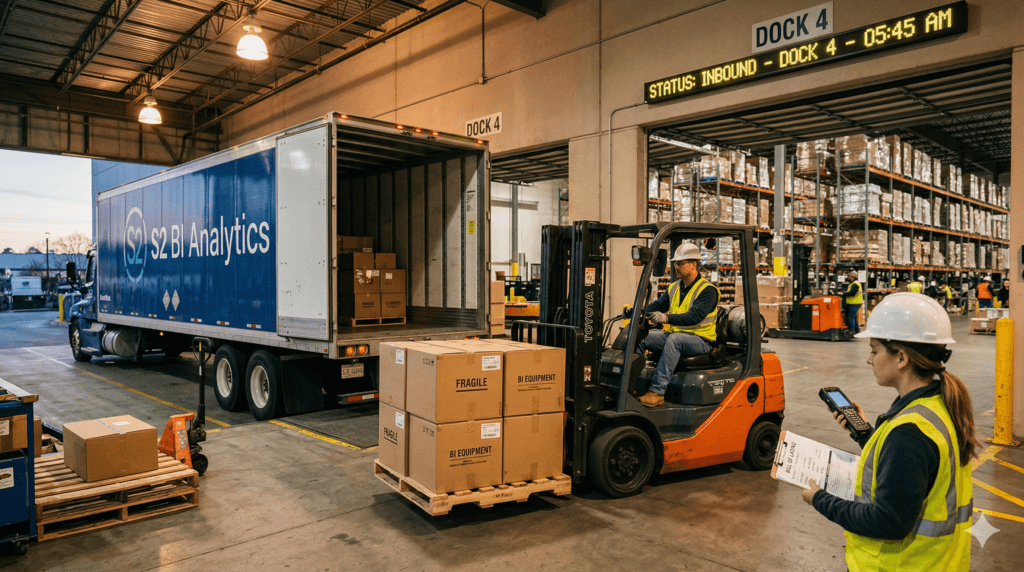
When that end-of-line trailer backs into your dock door, the clock starts. Everything that happens in the next few hours either sets your operation up for a clean day or plants problems you’ll be chasing the rest of the week. The warehouse receiving process is not complicated. But it is unforgiving if you skip steps.
Here’s how it works from terminal dispatch to WMS putaway confirmation.
TL;DR
What this covers: How LTL freight moves from the end-of-line carrier terminal through final delivery and into DC inbound receiving, including the documents that matter at the dock, the step-by-step receiving process, how FTL differs, and the four metrics every receiving operation should be tracking.
Who it’s for: DC supervisors, operations managers, supply chain students, and anyone who wants to understand what actually happens when an LTL trailer backs into a distribution center dock door.
What Happens at the End-of-Line Terminal Before the Trailer Hits Your Dock
Your freight doesn’t just show up. It was sequenced.
After your shipment clears the hub network, it lands at the destination terminal. Planners build city delivery routes by zone, stop density, and service commitments. Then they load trailers in a stop sequence — the last stop goes in first, the first stop loads last, tight to the doors. If your DC is stop three on a seven-stop run, your freight is buried somewhere in the middle of that trailer.
That matters. The driver can’t just pull your pallets and hand them over. Your receiving team has to work through freight headed somewhere else to get to yours. It’s one big reason LTL arrivals take longer per piece than a typical FTL inbound. If you want the full picture of how that freight got to the terminal in the first place, the global supply chain transportation modes post covers every leg of that journey.
When the driver pulls up to your gate, they’re carrying three documents you need to understand:
The Bill of Lading (BOL) is the contract of carriage. Shipper, consignee, piece count, freight class under the NMFC, freight terms. This is your verification baseline.
The PRO number is the carrier’s tracking and billing ID. Every status event, every claims conversation, every discrepancy resolution runs through this number.
The proof of delivery (POD) is where exceptions live. Damage, shortages, overages; if it doesn’t get written on the POD before you sign it, it doesn’t exist as far as the carrier is concerned.
Write that last one down somewhere. It’ll save you money.
Live Unload vs. Drop Trailer: Not the Same Decision
Before your team touches freight, you need to know what kind of delivery you’re dealing with.
Live unload means the driver waits at the dock while your team unloads. They get a signed POD and leave with an empty or repositioned trailer. This is the standard LTL scenario. Having the driver present when you find a discrepancy is genuinely useful. The trade-off is dwell time. LTL carriers track detention hours, and if your receiving process is slow, eventually that shows up on your invoice.
Drop trailer means the driver drops the loaded trailer, usually swaps it for an empty, and leaves. You unload on your own time. More common for high-volume FTL lanes and dedicated carrier relationships, though some large-volume LTL accounts negotiate it. The flexibility is real. So is the risk: without a yard management system, dropped inbound trailers have a way of sitting in the yard and getting forgotten.
For most facilities receiving standard LTL, you’re doing live unloads. Plan dock time accordingly.
The Warehouse Receiving Process, Step-by-Step Guide
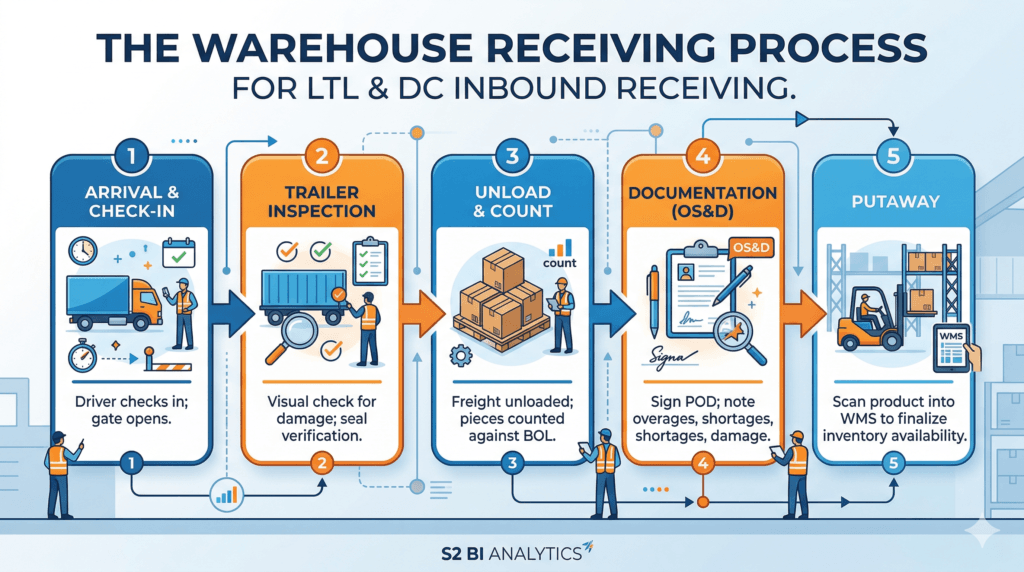
Dock Door Assignment and Trailer Check-In
In a well-run operation, dock door assignment doesn’t start when the driver pulls up. It starts the night before.
Your WMS or TMS pulls inbound appointment data, and the receiving supervisor allocates doors based on expected volume, freight type, and labor availability. When the driver checks in at the gate, the YMS (yard management system) logs the trailer, carrier, estimated contents, and arrival time. From there, the system directs the driver to the right door or a yard staging slot if the door isn’t ready yet.
Many DCs still manage this in spreadsheets and over the phone. That works until it doesn’t.
Trailer Inspection Before You Touch Anything
Before the first pallet comes off, check the trailer. This step is not optional.
You’re looking at: exterior damage to the trailer itself, the visible load condition from the doorway, and, for sealed loads, the seal number against the BOL. A broken or missing seal on an FTL trailer that should be sealed is a significant irregularity. Document it before you break anything open.
On LTL, there’s usually no origin seal. What you’re verifying is the visible condition and load integrity before you accept liability for what you can’t see yet. If anything looks wrong, write “subject to further inspection” on the POD before signing. That phrase protects you.
BOL Verification and ASN Matching
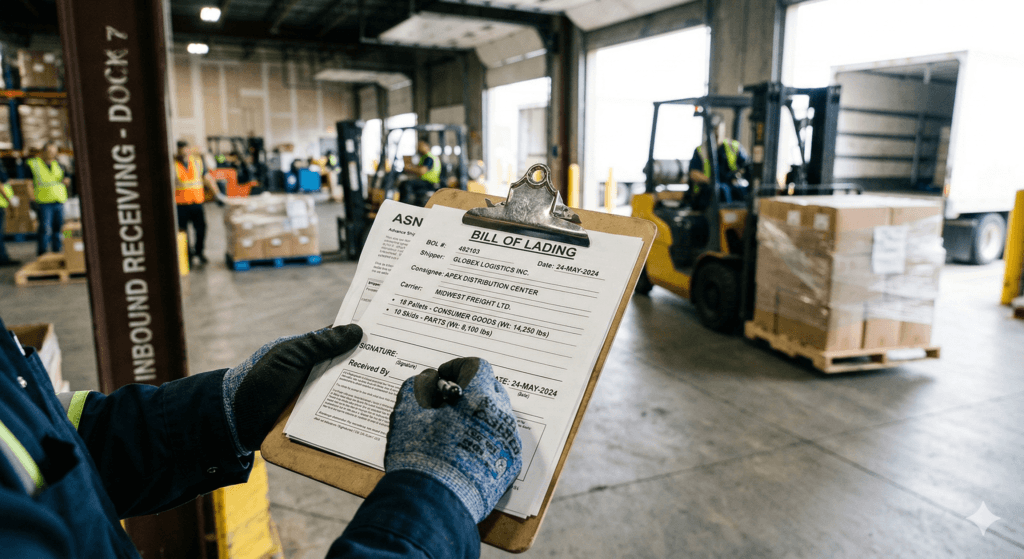
As freight comes off the trailer, your team is doing two things at once: counting and checking.
Count against the BOL. Every piece should match. If you’re expecting 12 pallets and 11 come off, that shortage goes on the POD before the driver leaves. If 13 come off, the overage is applied to the POD too. Overages aren’t free product; they get sorted out, but only if you documented them.
If your operation runs on advance ship notices (ASNs), your WMS has already created expected receipts for the shipment. Receivers scan against live data. Discrepancies are flagged as they occur, rather than being discovered during reconciliation an hour later. ASN-driven receiving is faster, cleaner, and produces better inventory data from the first scan. If you’re not using ASNs yet, that’s worth a conversation with your transportation team.
OS&D: The Part Most Operations Get Wrong
OS&D stands for overage, shortage, and damage. And the rule is straightforward: document everything on the POD before the driver leaves.
Visible damage. Missing pieces. Extra pieces. Wet or compromised packaging. Write it down and be specific. “One pallet damaged, corner crushed, product exposed to moisture” is useful in a claim. “Damage” is not.
Why does this matter so much? Under NMFC rules, you generally have nine months from delivery to file a freight claim. That sounds like plenty of time. It isn’t. King Solutions, which handles freight claims professionally, notes that for concealed damage, filing after five days becomes materially harder to win. The carrier’s argument will be that the damage happened after delivery.
A 2023 Flock Freight study found the average LTL damage rate was 1.94% of shipments, with average claim costs of $3,777 per damaged LTL shipment. At 50 LTL trailers a week, that math gets uncomfortable fast. Your POD documentation is your only insurance policy.
Standard NMFC rules give you 9 months to file a claim, but for concealed damage, you only have 5 business days to notify the carrier.
- Keep all original packaging and pallets.
- Take photos of the product exactly where it was found.
- Stop the putaway process immediately—moving the product can void the claim.
Putaway: From the Dock Floor to Pickable Inventory
Once freight is received, inspected, and reconciled against the BOL or ASN, it moves to putaway.
In a WMS-directed operation, the system assigns storage locations based on item velocity, cube, and product handling requirements. RF devices guide associates from the staging area directly to the bin, rack, or reserve location. Inventory updates in real time. From the moment the scan happens, the system knows exactly where that product lives.
WMS-directed putaway is the fastest way to lower your dock-to-stock cycle time for the product to go where someone decides to put it. Sometimes that decision is wrong. Sometimes it’s undocumented. Sometimes the pick operation never finds out. That’s when you get inventory that exists on paper and can’t be located on the floor.
How FTL Receiving Differs
FTL inbound is cleaner. One shipper. One BOL. One sealed trailer.
Your job is to verify the seal number matches the BOL, break the seal, count the freight, and receive it. Because the trailer moves from a single origin without the intermediate handling touches of the hub-and-spoke network, the damage rate is lower, and exceptions are less frequent.
FTL receiving breaks down when seal numbers don’t match the BOL (stop, document, get the carrier on the phone before unloading), when pallet or case counts are off versus the BOL (document on the POD, short-receive until it’s resolved), or when there’s load shift damage inside a sealed trailer.
Same principle as LTL. Just comes up less often.
The Four Receiving Metrics Worth Tracking
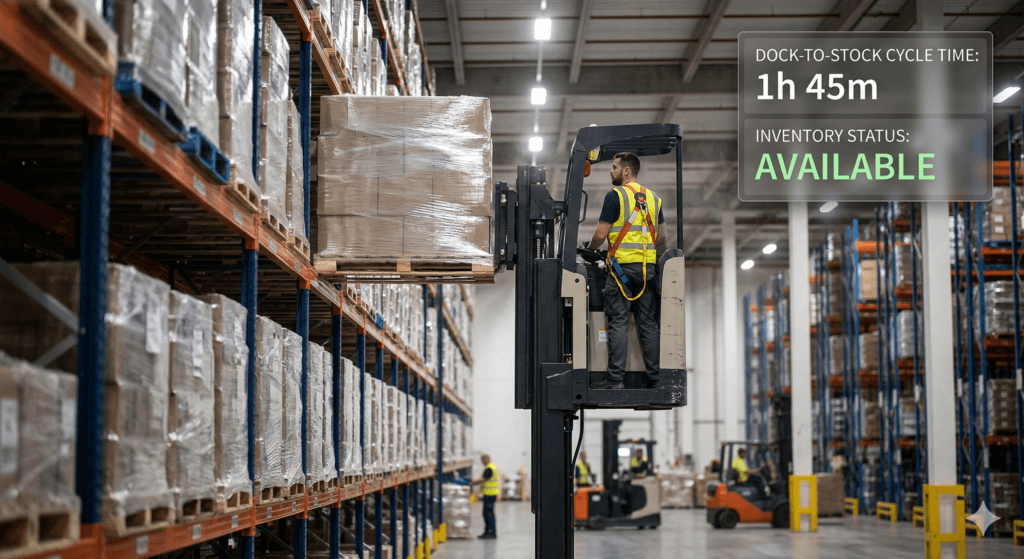
The receiving dock generates some of the most actionable data in your building. Most operations only track a fraction of it. Here are the four that matter:
Dock-to-stock cycle time is the most critical metric for the warehouse receiving process, measuring the total hours from freight arrival to WMS and shelf availability. WERC’s DC Measures data puts best-in-class at under two hours. The median is around 6.2 hours. If you don’t know your number, you don’t know where the time is going.
Receiving productivity is lines received and put away per person-hour. WERC benchmarks best-in-class at 60 or more lines per hour. Typical mid-tier operations run 20-27. That gap is real labor cost.
Receiving accuracy rate tracks the number of receipts processed without error. Target is above 99.5%. Every point below that is inventory inaccuracy you’ll be chasing in pick, pack, and ship downstream.
OS&D rate measures overages, shortages, and damage as a percentage of total shipments. The 1.94% LTL benchmark gives you a market reference. Spikes above that by carrier or vendor are worth investigating.
You don’t need expensive software to track these four. A spreadsheet and consistent data entry will give you trend data that can move the needle.
Where Receiving Actually Breaks Down
The most common failure mode isn’t a missing document or a bad carrier. It’s time pressure.
When inbound volume spikes and receiving is already behind, steps get skipped. The BOL doesn’t get checked properly. The POD gets signed without noting the damage. The count gets waved through because the dock supervisor is already managing two other live unloads. Freight gets staged without a WMS scan because it needs to be out of the doorway.
Every one of those shortcuts creates a problem somewhere downstream. Inaccurate counts corrupt inventory. An unsigned damage note means a denied claim. Unscannable staging means lost product. The DC doesn’t feel the pain right away. It shows up in pick errors, customer complaints, and cycle count variances a week later.
The receiving dock is where inventory accuracy is created or destroyed. Everything after this point, the picks, the orders, the outbound shipments run on data that was generated in the first two hours after freight arrived.
Get it right, and the rest of the building has a fighting chance.
What’s Next in This Series
This post covered what happens when LTL freight arrives at the DC dock. The next step is understanding how the DC floor itself is organized to receive, store, and move that freight once it’s in the building. That’s coming in How a Distribution Center Works. The metrics side of receiving and how it connects to broader DC performance measurement will be covered in the DC KPIs post.
For the inbound transportation picture that sets all of this up, start with How a Freight Terminal Works and Global Supply Chain Transportation Modes.
At S2 BI Analytics, the goal is to connect DC operations experience with the data and analytics layer that sits on top of it. The receiving dock is a good place to start that conversation.
Common Questions About the Warehouse Receiving Process
What is LTL receiving at a distribution center?
LTL inbound receiving is the process of accepting, inspecting, and reconciling less-than-truckload freight at a DC dock. Because LTL trailers carry freight from multiple shippers consolidated at carrier terminals, receiving involves verifying piece counts against the BOL, documenting any overages, shortages, or damage on the proof of delivery, and processing freight into the WMS before putaway. LTL receiving generates more exceptions per trailer than FTL because of the additional handling touches in the hub-and-spoke network.
What documents does an LTL driver bring to the receiving dock?
Three documents matter at LTL delivery. The Bill of Lading (BOL) is the contract of carriage listing shipper, consignee, piece count, and freight class. The PRO number is the carrier’s tracking and billing ID. The proof of delivery (POD) is where the receiver documents exceptions before signing. The POD is the most important document from a claims standpoint. Damage or shortage that isn’t noted on the POD at delivery is extremely difficult to recover on later.
What is dock-to-stock cycle time, and what is a good benchmark?
Dock-to-stock cycle time measures the hours from freight arrival at the dock to when it’s recorded as available inventory in the WMS. According to WERC’s DC Measures data, best-in-class operations hit under two hours. The median across surveyed operations is approximately 6.2 hours, with typical operations lasting between 4 and 8 hours.
What does OS&D mean in warehouse receiving?
OS&D stands for overage, shortage, and damage. It refers to any discrepancy between what the carrier’s documents say was delivered and what the DC actually received. All OS&D must be documented on the proof of delivery before the driver leaves. NMFC rules allow nine months to file a freight claim, but concealed damage becomes significantly harder to recover after five days from delivery.
How does LTL receiving differ from FTL receiving at the dock?
FTL receiving typically involves a single shipper, one BOL, and a sealed trailer, which makes it faster and simpler. LTL trailers carry freight from multiple shippers with more handling touches in the carrier network, which means more exception risk and more reconciliation work. A 2023 Flock Freight study found the average LTL damage rate was 1.94% across shipments. Both LTL and FTL require BOL verification, count confirmation, and OS&D documentation, but LTL demands more attention per trailer.
What is WMS-directed putaway, and why does it matter?
WMS-directed putaway is a process in which the warehouse management system assigns optimal storage locations based on item velocity, cube, and product characteristics, then directs operators via RF devices from staging to the bin location while updating inventory in real time. It reduces putaway errors, improves inventory accuracy, and replaces informal location decisions with rules-based logic that the entire operation can count on.