TL;DR — Bottom Line for DC Operators
What this covers: How an LTL freight terminal actually works — the hub-and-spoke routing network, freight classification and pricing, cross-docking operations, and why what goes wrong at the terminal shows up at your receiving dock two days later.
Who it’s for: DC managers, inbound supervisors, and supply chain professionals who want to understand the freight terminal leg of the inbound pipeline from someone who ran one.
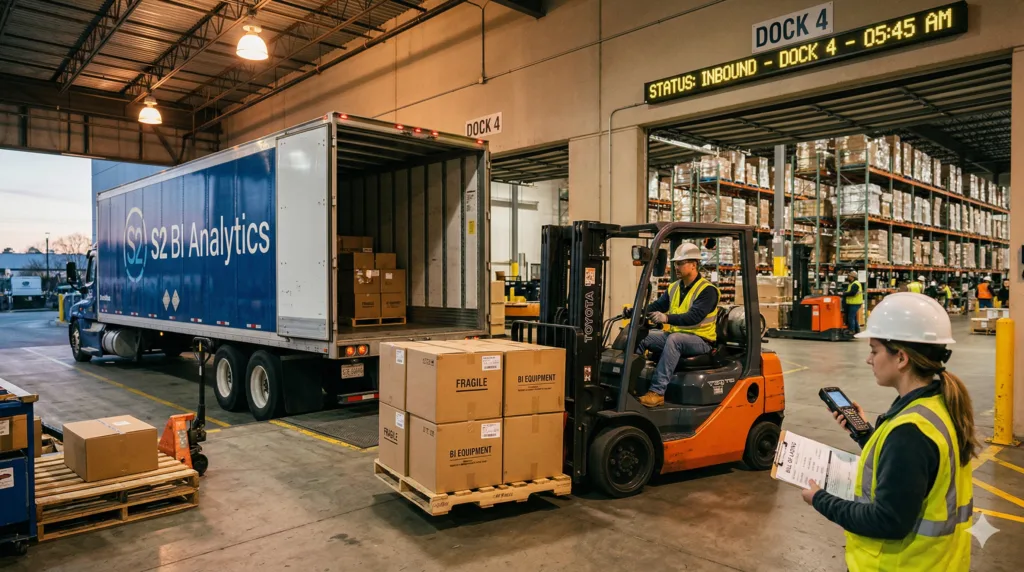
Most people have seen a semi-truck on the highway and thought nothing of it. A few more know that freight moves through warehouses before it gets to a store shelf. But what actually happens in between, at 3 in the morning, inside a building with 100 dock doors and forklifts running every direction? That’s the part nobody talks about.
I spent years running an LTL freight terminal for Yellow Freight in Texarkana, Texas, before eventually moving into distribution center operations at Gap Inc. I’ve been on both ends of this handoff. I’ve been the terminal manager loading the linehaul trailer at midnight, and the DC operations supervisor who has been waiting for that truck to back into my inbound dock at 6 AM. That dual perspective shapes everything in this post.
If you want to understand how a freight terminal works and how freight moves through the middle mile, this is the post for you. We’re going to cover how freight terminals are built and why, how LTL and FTL freight move differently, and the documents and data that hold it all together. To truly understand how LTL shipping works, you have to look at the ‘hand-off’ between the terminal and the distribution center, a gap where the data often breaks down in ways most shippers never see coming. There’s also a significant industry change you need to know about if you’re managing freight costs right now. More on that shortly.
This post builds on the transportation fundamentals covered in How the Global Supply Chain Really Moves. If you’re new to freight modes and want to understand ocean, air, and truckload at a high level first, start there. This post goes deep into the ground level of domestic freight movement.
LTL vs. FTL: LTL Freight Routing and Core Distinctions
Optimizing your LTL freight routing starts with understanding how carriers consolidate shipments to maximize trailer cube. Before anything else, let’s get the basic split right, because the entire terminal infrastructure exists because of it.
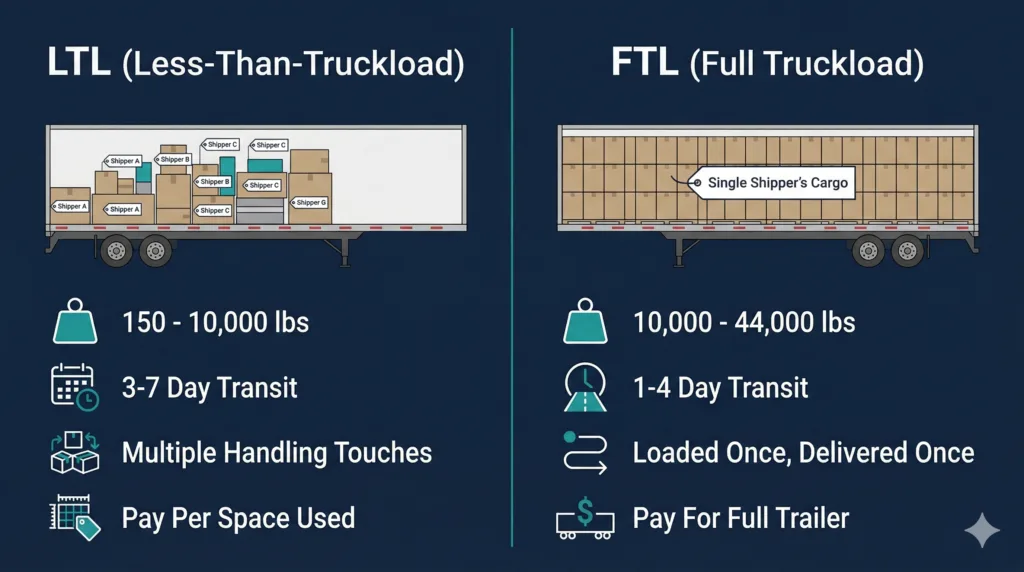
Less-than-truckload (LTL) means your freight doesn’t fill a whole trailer. You’re sharing space with other shippers. Shipments typically run from 150 to 10,000 pounds. You pay only for what you use, but your freight will make multiple stops, pass through at least one terminal, and get handled by multiple sets of hands before it reaches the consignee. LTL shipping works well for smaller, non-time-critical shipments where cost efficiency matters more than speed.
Full truckload (FTL) is one shipper, one truck, one destination. Once that trailer gets loaded at your dock, it doesn’t open again until it reaches the receiver. The rough threshold is 8 to 10 pallets or around 15,000 pounds. FTL is faster, has far fewer handling touches, and is the right call when you’re moving volume, freight is fragile or high-value, or timing is critical.
The difference matters operationally. Every time LTL freight changes hands, it’s another opportunity for delay, damage, or a scan gap in your data. FTL freight loads once and delivers once. That simplicity is worth something.
Here’s a practical comparison:
| Factor | LTL | FTL |
|---|---|---|
| Shipment size | 150–10,000 lbs / 1–7 pallets | 10,000–44,000 lbs / 8+ pallets |
| Transit time | 3–7 days via hub network | 1–4 days, direct routing |
| Cost structure | Pay per space used | Pay for a full trailer |
| Handling exposure | Multiple terminal touches | Loaded once, delivered once |
| Data risk | Higher — scan gaps at each transfer | Lower — clean chain of custody |
If your freight is consistently hitting that 8–10 pallet threshold, you should be running a cost-per-unit analysis on LTL vs. FTL regularly. The breakeven moves around more than most shippers realize.
How a Freight Terminal Works: Facility Types and Freight Terminal Operations
Not all terminals are the same. The LTL network runs on a few distinct facility types, each with a different role in moving freight from origin to destination.
Local Service Centers
The local service center is where most shipments begin and end. This is where pickup-and-delivery (P&D) trucks begin their routes in the morning and return at night. Freight collected throughout the day gets unloaded, sorted, and consolidated onto linehaul trailers heading for larger hubs. On the receiving end, linehaul trailers arrive early in the morning, freight gets sorted by delivery route, and P&D trucks head out.
Smaller service centers might have fewer than 20 dock doors. Midsized facilities run around 40 to 50. The point isn’t the size. It’s the throughput and the speed of the sort.
Breakbulk Terminals
This is where the real action is. A breakbulk terminal is the network’s hub. Linehaul trailers arrive from dozens of origin service centers, the loads get broken down, freight is re-sorted by final destination region, and new outbound linehaul trailers get built for the next leg.
Think of it like a hub airport. The flights from smaller cities all converge, passengers connect, and new flights depart to other destinations. Without the hub, you’d need a direct flight between every possible city pair. The math doesn’t work. The same principle applies here.
These facilities get large. Old Dominion recently expanded its Indianapolis breakbulk from 223 to 325 dock doors, and that’s not unusual at the major hub level. They’ve invested approximately $2.4 billion in service center expansion since 2015, with another $575 million planned for 2025 alone.
Running one of these is a different kind of operation than a local service center. The freight volume, the routing complexity, the dock door assignment decisions, it all compounds at scale.
Strip Doors and Stack Doors
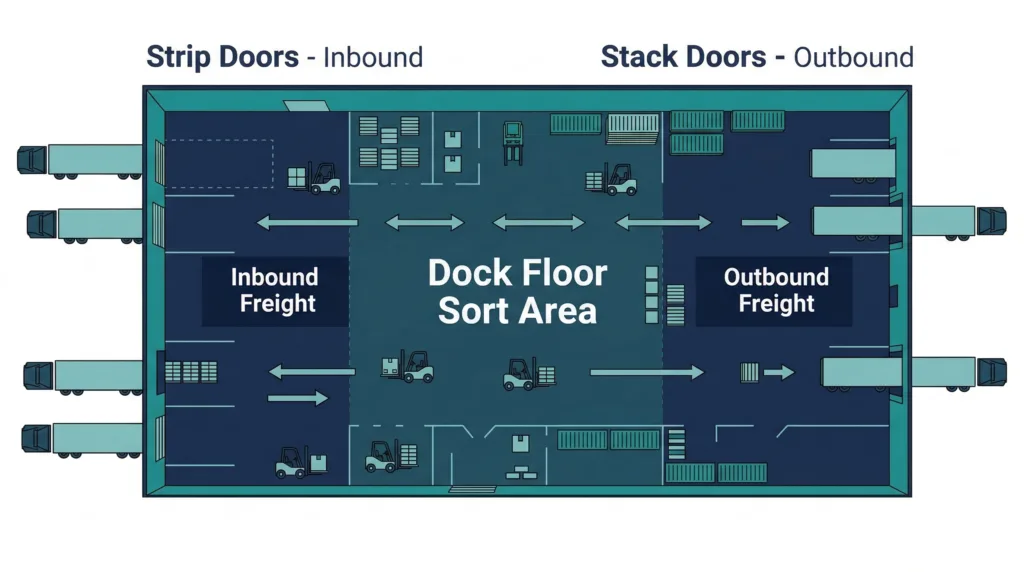
Inside any LTL terminal, the physical layout is driven by one objective: get freight from the inbound door to the outbound door with as little travel distance as possible.
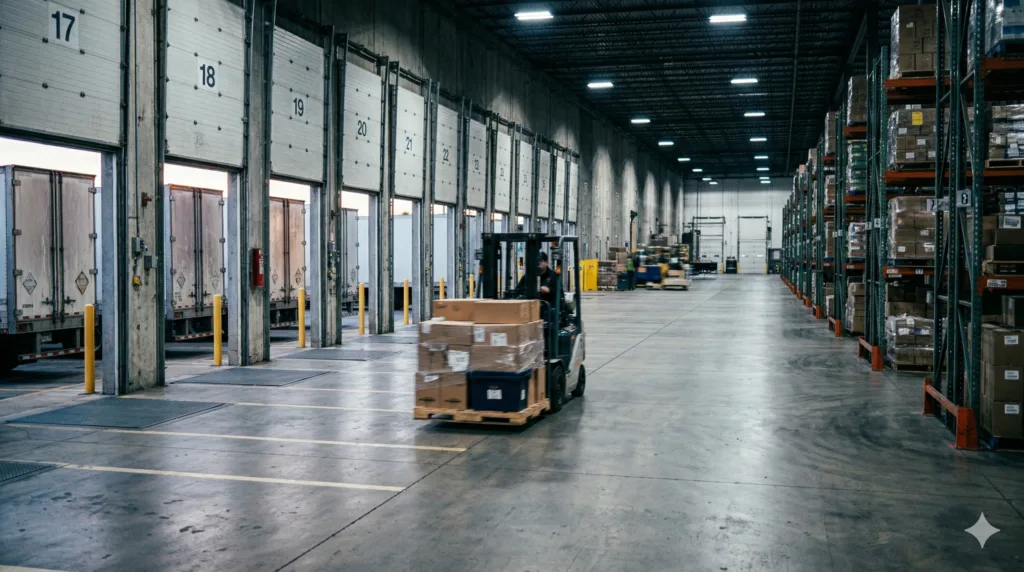
Strip doors are inbound. Linehaul trailers back in, get unloaded, freight gets scanned and sorted on the dock floor.
Stack doors are outbound. Sorted freight moves to the designated stack door and gets staged and loaded onto the outbound trailer heading for that freight’s next stop.
In a 100-door breakbulk terminal, every extra foot a forklift travels between a strip door and a stack door is wasted labor cost and cycle time. That’s why carriers invest heavily in planning tools that pre-assign strip door positions to incoming trailers based on where their freight is going. Better door assignment means shorter internal travel, faster sort cycles, and trailers departing on time for their linehaul run. It all connects.
I spent a lot of nights at Yellow making those door assignment calls. It’s one of the more underappreciated levers in understanding how a freight terminal works at the operational level.
Cross-Dock Facilities
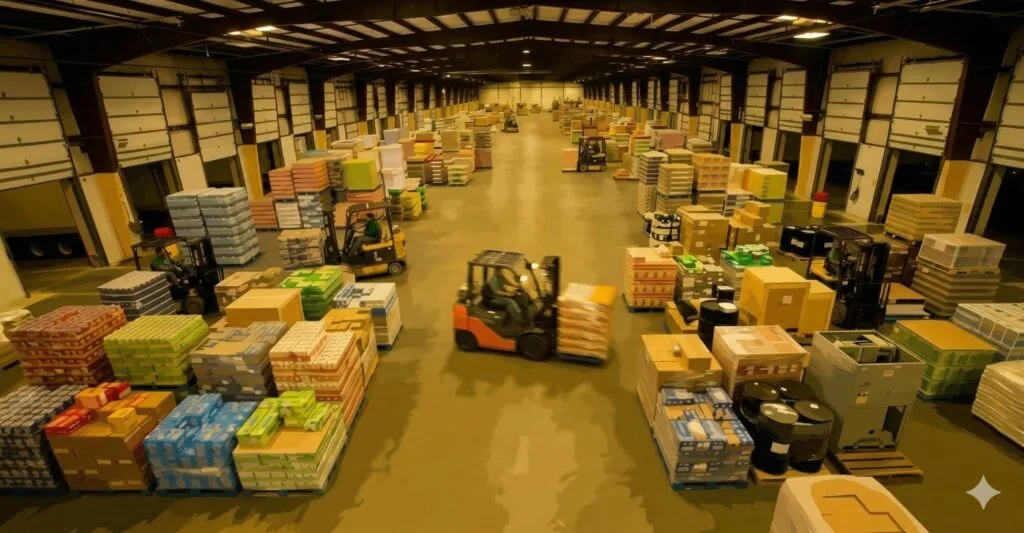
Cross-docking is a flow-through model with no storage. Freight arrives inbound, gets sorted, and moves directly onto outbound trailers. Nothing sits on a shelf. Done right, it’s one of the most efficient freight handling models there is. Walmart built its retail dominance partly on a cross-docking strategy that let it replenish stores faster than competitors who were running traditional warehouse models.
Within LTL terminal operations, direct cross-docking is actually the standard method for moving freight from an inbound unit to an outbound linehaul trailer. The terminal isn’t a warehouse. Freight isn’t supposed to sit there.
FTL Drop Yards and Relay Points
FTL freight generally doesn’t use an LTL-style terminal, but it does have its own infrastructure. Drop yards are staging areas where pre-loaded trailers wait for drivers. Instead of a live load where the driver waits while you load, your team pre-stages a loaded trailer, and the driver picks it up and goes. Drop-and-hook operations are faster, give you more flexibility on timing, and keep driver detention costs down.
Relay points are used on long-haul lanes to manage federal hours-of-service limits. Driver one brings the loaded trailer to a designated relay point, drops it, and Driver two picks it up and continues. The trailer doesn’t stop. The drivers do.
Intermodal Ramps
For longer hauls, intermodal facilities are where truck meets rail. Specialized cranes lift sealed containers off truck chassis and place them on rail flatcars, usually double-stacked. The container never opens. No freight gets handled at the ramp. It’s a pure transfer point.
Rail’s cost advantage over FTL truck becomes meaningful on lanes of 500 miles or more. The trade-off is between transit time and reduced scheduling flexibility. If you want the full breakdown on how intermodal fits into the broader freight landscape, that’s covered in detail in the global supply chain post. And if you want to understand what happens when the port side of that equation backs up, how port congestion ripples through your DC covers how delays at the origin port work their way inland through the intermodal chain and eventually land on your receiving dock.
How LTL Freight Actually Moves: Step by Step
Here’s the journey from shipper to consignee, with no steps glossed over.
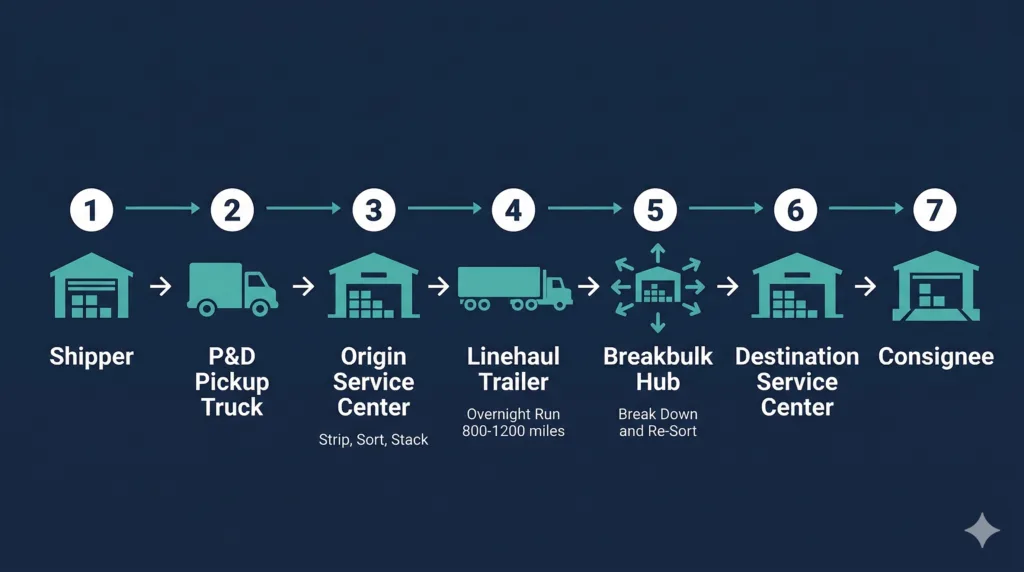
Step 1: Pickup
A local P&D truck swings by the shipper’s facility, usually as one stop on a multi-pickup route. The driver verifies the freight against the Bill of Lading (BOL), confirms piece count and condition, and the carrier assigns a PRO number to the shipment. That PRO number is now the shipment’s ID for every step that follows.
The data chain starts here. If the BOL has errors, if the weight is wrong, if the freight class is misclassified, you’ll feel it later in the form of invoice disputes, unexpected charges, or a claim that doesn’t go your way.
Step 2: Origin Service Center
The P&D truck delivers collected freight to the origin service center. Freight comes off at the strip doors, gets scanned, and the TMS routes each piece to its designated outbound stack door based on destination. Three different things might happen from here, depending on volume and the shipper relationship:
- Standard cross-dock: Freight transfers directly from strip to stack, loaded onto the outbound linehaul trailer
- Headload: A large shipper’s freight fills the nose of the linehaul trailer first; the terminal then fills the remaining space with other shipments heading the same direction
- Breakbulk directional loading: High-volume shippers who load their own trailers at origin can send freight directly to the first breakbulk hub, skipping origin dock cost entirely
That third option is one of those things your carrier rep can arrange if you’re consistently moving volume. Most shippers don’t ask. The ones who do get a real service and cost advantage.
Step 3: Linehaul Departure
Outbound linehaul trailers depart in the evening, typically between 8 PM and 11 PM. The timing is intentional. An overnight run covering 400 to 800 miles puts the trailer at the destination facility before dawn, giving the morning crew time to sort and stage before P&D trucks need to be loaded and rolling.
National carrier linehaul runs can cover 800 to 1,200 miles. Regional carriers often operate shorter legs with next-day or second-day service windows, resulting in fewer handling touches and generally lower claims rates. Many carriers also run twin trailers (doubles) on linehaul, which improves cube utilization and allows one trailer to drop at an intermediate terminal while the other continues on.
Step 4: Breakbulk Hub
On longer routes or cross-regional lanes, the linehaul trailer arrives at a breakbulk hub. The load gets broken down, freight is sorted by destination region, and outbound linehaul trailers are built for the next leg of the journey.
The hub-and-spoke model exists because the math demands it. A purely point-to-point network connecting N service centers requires roughly N-squared direct routes to cover every possible lane combination. A hub-and-spoke model reduces that to about 2N routes, which means every lane runs with enough freight to fill a trailer. That’s how you keep cost per shipment manageable across a national network.
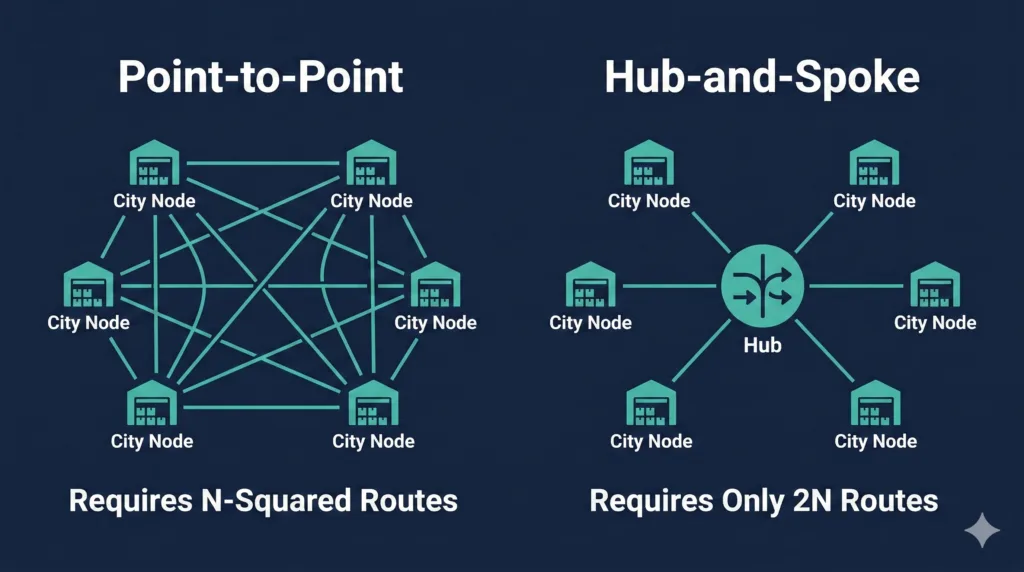
Not every shipment hits a breakbulk. Regional moves on high-density lanes often go point-to-point. But for anything crossing regional boundaries, the hub is part of the journey.
Maximizing Efficiency in LTL Freight Routing
“To maintain efficiency at these hubs, carriers use advanced load-planning software to ensure that every trailer leaving the breakbulk is cubed out. This is where the data from the origin terminal meets the reality of the road, and it’s the most critical point for ensuring your freight stays on schedule
Step 5: Destination Service Center
The linehaul trailer arrives at the destination terminal. Freight comes off, gets sorted by delivery route, and P&D delivery trucks get loaded in reverse delivery order. The last stop on the route is loaded first. First stop gets loaded last. It sounds simple. It’s one of those things that kills your morning if someone loads it wrong.
Step 6: Final Delivery and POD
The P&D driver makes a route of multiple deliveries. The consignee signs the Proof of Delivery (POD). What happens at the POD signature matters a great deal if there’s a problem. A clean signature with no noted exceptions is a barrier to any damage claim you try to file later. More on that in the OS&D section below.
The Documents That Run the Network
Three documents govern every LTL shipment. Understanding them isn’t paperwork knowledge. It’s how you protect yourself when things go wrong and how you keep your freight cost data clean.
The Bill of Lading
The BOL is simultaneously a receipt for freight, a contract between the shipper and the carrier, and a document of title. Federal regulations under 49 CFR Part 373 require motor carriers to issue a BOL upon shipper request.
Three parties own it. The shipper creates or authorizes it and warrants the accuracy of the commodity description, weight, piece count, and freight class. The carrier accepts it. The driver’s signature is the moment liability transfers to the carrier under the Carmack Amendment. The consignee signs the POD at delivery.
BOL errors are where unexpected invoice charges come from. Wrong weight, misclassified freight, inaccurate commodity descriptions, they all create reclassification opportunities for the carrier and disputes for you. Get the BOL right at the origin. That’s where the data either starts clean or starts broken.
The PRO Number
The PRO number (Progressive Rotating Order) is the carrier’s internal tracking and billing identifier. It follows the shipment through every terminal handling event. Dock workers scan it at each transfer, which is how you get transit visibility in carrier portals. It’s also how freight bills are matched to deliveries and how claims are referenced when something goes wrong.
From a data standpoint, the PRO number is the primary key of the freight transaction. When PRO tracking breaks, usually from scan gaps at terminals or interline handoffs between carriers, you lose visibility into where your freight is and when it was moved. That data gap is expensive to manage reactively. It’s one of the first things a transportation analytics layer should be monitoring.
The Proof of Delivery
The POD closes the transaction. The consignee’s signature is what the carrier points to if you file a damage claim and they want to push back. This is where the specificity of your team’s exception notation matters. “Damaged” is a weak claim. “3 cartons crushed, visible corner impact on top layer, shrink wrap torn, pallet leaning” is an actionable record. Train your receiving team on this. It pays off when you need it.
Freight Classification: The NMFC System and Why It’s Changing
Understanding NMFC freight classification is non-negotiable if you’re managing freight spend. LTL pricing doesn’t work like FTL, where you negotiate a rate per mile. LTL pricing is based on the National Motor Freight Classification (NMFC), administered by the National Motor Freight Traffic Association. Understanding it is non-negotiable if you’re managing freight spend.
How Classification Works
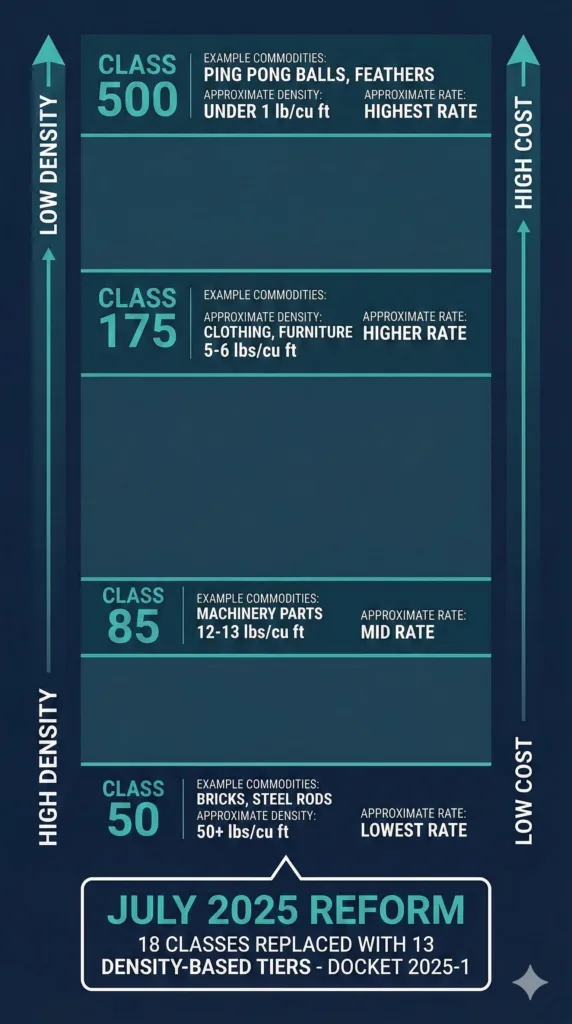
The NMFC assigns every commodity one of 18 freight classes ranging from Class 50 to Class 500. Four factors drive the assignment:
- Density — Weight per cubic foot. This is the most important factor by a wide margin
- Stowability — How easily it loads and stacks in a trailer
- Handling — Special care requirements like fragility, hazmat, or oversized dimensions
- Liability — Risk profile for damage, theft, or spoilage
Lower class means denser, easier freight, and lower rates. Higher class means the opposite. Class 50, which covers items such as steel rods and bricks, runs around $200 per hundredweight. Class 500, which covers ping pong balls and feathers, can exceed $800 per hundredweight. That’s a 300% price spread for the same weight and distance, based entirely on what you’re shipping.
Misclassification is one of the most common and expensive mistakes in freight management. Research suggests misclassified shipments cost an average of 30-50% more than correctly classified freight once the carrier reclassifies on its end and invoices accordingly.
The July 2025 Density Reform
Here’s the part that should be on your radar right now if it isn’t already.
In July 2025, NMFTA launched Docket 2025-1, the most significant overhaul to freight classification in over 70 years. The 18 freight classes are being replaced with 13 density-based tiers. Over 2,000 NMFC codes are being consolidated into simplified categories. For most shipments, density alone now determines the class. The subjective assessments around stowability and handling that drove so many disputes are largely gone.
New laser scanners and 3D dimensioning tools at terminals enable automated measurement, allowing carriers to calculate density more accurately at intake than ever before. NMFTA estimates that this reform will affect over 40% of all products currently shipped.
If your freight cost analytics model is built on class-based logic, it needs to be updated. Any dashboard tracking freight cost per unit that was calibrated on the old 18-class structure will start throwing misleading numbers as the new tiers roll through carrier rate systems. This is exactly the kind of industry change that creates invisible cost variances for shippers who aren’t paying attention.
Accessorial Charges: The Hidden Cost Layer
Base freight rates are only part of what you actually pay. Accessorial charges apply when a shipment requires services beyond standard dock-to-dock handling. They’re legitimate. They cover real extra labor and equipment. But they quietly drain freight budgets when nobody’s watching the data.
| Charge Type | When It Triggers | Typical Range |
|---|---|---|
| Liftgate service | No dock or forklift at pickup/delivery location | $75–$150 |
| Residential delivery | Home address or non-commercial site | $75–$175 |
| Detention | Truck held beyond the allowed window at a dock | Per 15–30 min increment |
| Redelivery | Missed appointment or refused delivery | Fee per attempt |
| Reconsignment | Address change mid-shipment | Admin + rerouting fee |
| Inside delivery | The driver must move freight past the threshold | Variable |
Here’s the thing about accessorials that most freight cost analysis misses. They’re not just line items. They’re process failure signals.
A spike in liftgate fees on a specific lane means equipment needs aren’t being communicated at booking. Recurring detention charges at a particular facility mean your dock scheduling has a bottleneck that’s pushing past the carrier’s free time window. Residential delivery fees appearing on commercial shipments indicate that customer address data has issues upstream. Each of those is a fixable process problem. But you can only see it if you’re tracking accessorials by type, by lane, and by facility, not just as a lump sum on your freight invoice.
One more thing worth knowing: accessorial charges often appear on invoices 30 to 60 days after delivery. If you’re trying to run real-time freight cost visibility, that lag matters. A TMS that pre-accrues expected accessorials based on shipment characteristics is the fix, but most smaller shippers are working without one.
OS&D: When Freight Doesn’t Arrive Right
OS&D stands for Overages, Shortages, and Damages. It’s the formal framework for freight exceptions, situations where what physically arrived doesn’t match the BOL.
Overages: You received more units than the BOL documents. Sounds like a good problem. It’s not. It creates inventory discrepancies and liability questions about who owns the extra freight.
Shortages: Fewer units arrived than expected. Triggers claims, disrupts fulfillment, and creates downstream inventory problems.
Damages: Freight arrived physically compromised. Crushed, punctured, wet, structurally compromised.
LTL has inherently more OS&D exposure than FTL because every handling touch is an opportunity for something to go wrong. A shipment that moves through a pickup truck, an origin service center, a breakbulk hub, a destination service center, and a delivery truck has five handling events before it reaches you. Each one is a point of potential failure.
The POD signature moment matters here more than most receiving teams realize. Note exceptions before you sign. Be specific. “Damaged” gives a claims adjuster almost nothing to work with. “Two cartons crushed on the top layer, corner impact visible on the lead pallet, shrink wrap torn on the right side, unit count verified short by four pieces” is a claim that has legs.
From a data standpoint, OS&D is one of the richest signals in your freight network. High damage rates on a specific lane or carrier terminal point to handling problems at that facility. Recurring shortages of specific commodities might indicate miscounting at the origin or something worse. OS&D trending by carrier and by terminal is one of the most useful datasets you can build for carrier performance management and contract negotiation.
The Scale and State of the LTL Market
It’s worth having context on the industry you’re dealing with. The U.S. LTL market was valued at $40.5 billion in 2024 and is projected to reach $66.2 billion by 2034. The North American market, including Canada, is already at $84.6 billion.
There are roughly 200 active LTL carriers in the U.S., but the top 25 control 91% of the $52.8 billion market. FedEx Freight leads at $9.1 billion in annual revenue with 326 terminals. Old Dominion runs 261 service centers. The total LTL terminal count across the sector reached 3,216 facilities in 2024.
The Yellow Corp collapse is still worth understanding as a market context. Yellow filed for Chapter 11 in August 2023, holding roughly 8 to 9% market share, 14,000 trucks, and 169 terminals across North America. It was the largest LTL failure in decades. A federal judge approved their final liquidation plan in December 2025. The market absorbed the volume and restabilized, but the consolidation that it accelerated among the remaining top carriers has been real. Old Dominion submitted a roughly $1.5 billion bid for Yellow’s terminal holdings during the proceedings.
I ran a Yellow terminal for years. Watching that end the way it did was something.
Terminal KPIs: What Good Looks Like
Whether you’re managing a terminal or shipping through one, these KPIs are central to how a freight terminal works from a performance standpoint. They tell you whether the operation is running or struggling.
| KPI | What It Measures | Why It Matters |
|---|---|---|
| Dock utilization rate | % of time dock doors are actively in use | Low = idle capacity, near 100% = bottleneck risk |
| Shipments per hour | Dock throughput | Core staffing and labor efficiency benchmark |
| On-time delivery rate | % within committed service window | Primary carrier performance metric |
| Dock-to-stock time | Trailer arrival to freight availability | Directly impacts the downstream DC receiving |
| Truck dwell time | Total time trailer sits at a facility | High values generate detention charges |
| OS&D rate | Exceptions per 1,000 shipments | Carrier quality and handling performance signal |
| Appointment turnaround time | Time to fully load or unload a trailer | Labor efficiency and freight complexity indicator |
The shipments-per-hour metric is one I watched closely at Yellow. It’s the core industrial engineering standard for dock labor planning. Too low and you’re either understaffed or handling freight with complexity that the rate doesn’t account for. A good rate varies by facility type and freight profile, but the trend matters more than the number itself.
The BI Layer: Where the Data Is and Where It Breaks
The freight network generates an enormous amount of data. Most of it goes underused. Part of truly understanding how a freight terminal works is knowing where the data lives, where it breaks, and what tools actually help you see it.
Where the Data Lives
Every PRO scan at a terminal handling event creates a timestamp record. BOL data captures commodity, weight, class, and origin/destination. Accessorial charges on freight invoices document exceptions at the shipment level. OS&D reports capture exception type, location, and resolution. Carrier EDI feeds bring tracking events into a TMS in near-real time. That’s a lot of signal, and most shippers are only looking at a fraction of it.
Where It Breaks Down
Four failure points show up consistently. PRO tracking gaps occur when freight moves between carriers on interline shipments, or when terminal handling events don’t generate a scan. Scan gaps are a real problem at manual handling events inside older breakbulk facilities. OS&D data is often under-reported because inconsistent exception notation at delivery creates noisy records that are hard to analyze. And accessorial charge latency, charges hitting invoices 30 to 60 days post-delivery, makes real-time freight cost visibility nearly impossible without pre-accrual logic in your TMS.
The Analytics Use Cases Worth Building
Here’s where a BI layer actually moves the needle on freight management:
- On-time performance by lane, carrier, and day of week — separates systemic carrier failure from random variance. Day-of-week patterns often reveal terminal staffing issues that your carrier rep will never volunteer.
- Accessorial charge analysis by type, facility, and customer — surfaces process failures that are hiding as cost overruns. Liftgate fee spikes by lane almost always trace back to a booking process problem.
- OS&D trending by carrier terminal — the dataset most shippers ignore until they need to file a large claim. Build it before you need it.
- Freight cost per unit shipped — the number that connects transportation to P&L. Without a BI layer, most companies only see this quarterly at best.
- Dock utilization and truck dwell dashboards — on the DC receiving side, this is where detention charge prevention lives.
Tools That Support This Work
The TMS (Transportation Management System) is the operational data spine. For LTL specifically, it needs to handle automated rating, BOL and PRO number generation, multi-carrier tracking via EDI, freight bill audit and matching, and exception management. Platforms like GlobalTranz and MercuryGate handle mid-to-large shipper complexity. Smaller operations often work with carrier portals and spreadsheets, which work until they don’t. If you’re managing freight cost tracking in Excel before you’re ready for a full platform, this breakdown of essential Excel functions covers the formulas that do the heaviest lifting in supply chain cost analysis.
For real-time visibility across carriers and modes, FourKites and Project44 are the platforms most large shippers have standardized on. They aggregate tracking events from carrier EDI feeds and provide exception alerting when shipments fall off track.
Power BI is where I do most of my freight analytics work, pulling from carrier invoice exports and TMS data into dashboards that track cost per unit, accessorial trends, and carrier on-time performance by lane. It’s not plug-and-play with freight data. The data prep is real work. But the visibility it creates is worth it, especially when you’re walking into carrier rate negotiations.
For shippers who want to start somewhere accessible, most major carriers now offer robust portal dashboards with lane-level service and billing analytics. It’s not a TMS replacement, but it’s a reasonable starting point for shippers who aren’t ready to invest in a full platform.
What Happens When That Truck Backs into Your DC
The LTL journey ends when the P&D delivery truck backs into your inbound dock. The BOL is verified, the freight is released, and exceptions are noted on the POD. From that moment forward, the freight leaves the carrier’s operation and enters yours.
What happens next, appointment scheduling, inbound receiving, putaway, WMS-driven slotting, and the labor planning that governs all of it, that’s the subject of the next post in this series. It picks up exactly where this one ends, at the dock door. For the full breakdown of what happens on the DC side of that handoff, see DC Inbound Receiving: What Dock-to-Stock Time Actually Measures .
The terminal and the DC are two different worlds, connected by a shared seam. What happens on the carrier side directly affects your receiving productivity. Dock-to-stock time, trailer dwell, and inbound data quality don’t belong to just one team. They belong to the relationship between two operations that don’t always communicate as well as they should.
To truly understand how LTL shipping works, you have to look at the ‘hand-off’ between the terminal and the distribution center. I’ve stood in both places. The perspectives from each side differ in ways worth understanding before you try to solve a problem under pressure.
Frequently Asked Questions
How does an LTL freight terminal work?
An LTL freight terminal is a consolidation and sorting hub that moves freight from multiple shippers through a shared network. Pickup-and-delivery trucks collect freight from shippers throughout the day and bring it to the origin service center. There, it gets scanned, sorted by destination, and loaded onto linehaul trailers that depart overnight. On the receiving end, linehaul trailers arrive early in the morning, freight is sorted by delivery route, and P&D trucks head out to make deliveries. The whole system runs on tight timing — the overnight linehaul window exists specifically so freight arrives at the destination terminal before dawn, and delivery trucks can be loaded and on the road by morning.
What is the difference between LTL and FTL shipping?
LTL (less-than-truckload) means your freight shares trailer space with other shippers — you pay only for the space you use, but your shipment will pass through multiple terminals and get handled several times before delivery. FTL (full truckload) means one shipper fills the whole trailer, it loads once, and it delivers once without opening again. The practical threshold is roughly 8 to 10 pallets or 15,000 pounds — above that, FTL usually makes more sense on both cost and transit time. LTL is the right call for smaller, non-time-critical shipments where cost efficiency matters more than speed. Every extra handling touch in an LTL move is one more opportunity for delay, damage, or a scan gap in your tracking data.
What is cross-docking, and how does it work at a freight terminal?
Cross-docking is a flow-through model where freight arrives inbound, gets sorted, and moves directly onto an outbound trailer without going into storage. At an LTL terminal, this is actually the standard operating model — freight isn’t supposed to sit there. The inbound trailer backs into a strip door, freight gets unloaded and scanned, and it moves across the dock floor to the designated outbound stack door for its next destination. Done right, a well-run cross-dock keeps freight moving fast enough that nothing touches the floor twice. The efficiency of that sort process — specifically how well strip doors and stack doors are assigned relative to where the freight is going — is one of the biggest levers in terminal throughput.
How does freight classification affect LTL shipping costs?
Freight classification under the NMFC system is one of the primary drivers of what you actually pay for LTL shipping. The system assigns every commodity one of 18 freight classes based on density, stowability, handling requirements, and liability risk. A lower class means denser, easier freight, and lower rates; a higher class means the opposite. The spread is significant: Class 50 freight runs around $200 per hundredweight while Class 500 can exceed $800 per hundredweight for the same weight and distance. Misclassified shipments cost an average of 30-50% more after the carrier reclassifies them on their end. And if your freight cost model was built on the old 18-class structure, you need to know that NMFTA’s July 2025 Docket 2025-1 reform replaced those 18 classes with 13 density-based tiers — the most significant overhaul to the system in over 70 years.
What happens to my shipment at a breakbulk terminal?
At a breakbulk terminal, the linehaul trailer from your origin service center gets unloaded, your freight is sorted by destination region, and it gets loaded onto a new outbound linehaul trailer heading toward the next leg of its journey. Think of it like a connecting flight — your freight arrived from a smaller city, connected at the hub, and is now departing toward its final destination. The breakbulk hub exists because the math of a purely point-to-point network doesn’t work at a national scale. Routing all freight through hubs reduces the required lane combinations from roughly N-squared to about 2N, which keeps LTL cost-per-shipment manageable. Not every shipment hits a breakbulk — regional moves on high-density lanes sometimes go point-to-point — but anything crossing regional boundaries is going through one.
Questions about freight classification, carrier selection, or building a freight analytics layer for your operation? Drop them in the comments. I read every one.