Pick up almost anything within arm’s reach right now. A phone. A coffee mug. A pair of headphones. Odds are that the item touched at least three or four different global supply chain transportation modes before it landed in your hands, and most people have no idea that journey even happened.
That’s not a knock on anyone. The global supply chain transportation modes that move modern commerce are genuinely complex, and most introductory courses skip the operational mechanics in favor of high-level frameworks. But if you’re working in transportation, distribution, or procurement, or heading there, you need to understand how freight actually moves. Not just “it goes on a ship,” but the handoffs, the players, the delays, and the data (or complete lack of it) holding everything together.
This post breaks it down from the ground up. Every major mode. How they connect. Who manages what? And where visibility falls apart. By the end, you’ll have a mental model of global logistics that holds up whether you’re sitting in a classroom or standing on a DC floor.
Want to stay current on freight markets as you build this knowledge base? FreightWaves, Supply Chain Dive, and the Journal of Commerce are the three publications worth bookmarking.
Prefer to listen and watch? Here’s the full whiteboard explainer for this post:
The World’s Major Trade Corridors
Before getting into individual modes, it helps to understand where global supply chain transportation modes actually operate, because the corridor shapes everything: carrier options, transit times, documentation requirements, and risk.
Trans-Pacific (Asia → North America) is the highest-volume container trade lane on the planet. Chinese exports alone account for a massive share of US import volume. The westbound return flow of American agricultural products, waste paper, and scrap metal is significantly lighter, which is why repositioning empty containers back to Asia is a chronic structural problem.
Asia–Europe runs a close second. Freight moves either all-water through the Suez Canal or, increasingly, via rail across Central Asia on the so-called “New Silk Road” corridors.
Transatlantic (US–Europe) is smaller by volume but remains critical for high-value manufactured goods, pharmaceuticals, and industrial equipment.
Intra-Asia is the fastest-growing corridor, driven by regional manufacturing networks across Vietnam, Bangladesh, India, and Indonesia, which have created enormous short-sea and feeder vessel demand connecting secondary ports to major hub gateways.
Understanding which corridor your freight moves on tells you a lot before you ever touch a rate quote.
The Seven Global Supply Chain Transportation Modes
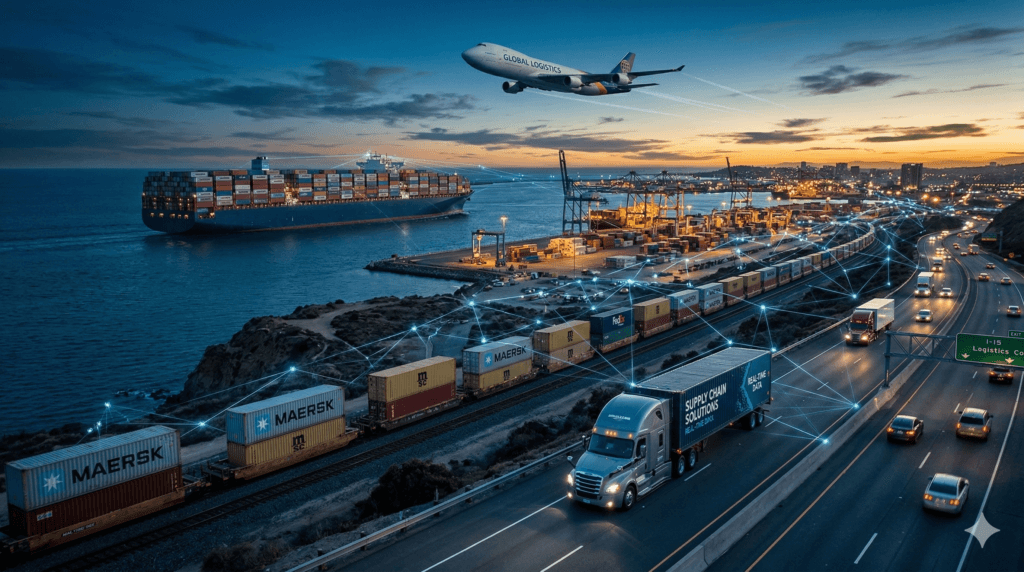
Global logistics runs on seven primary modes — what practitioners call the core supply chain logistics modes. Each one has a job, defined by cost, speed, cargo type, and geography. You don’t pick one and stick with it. You sequence them.
1. Ocean Freight
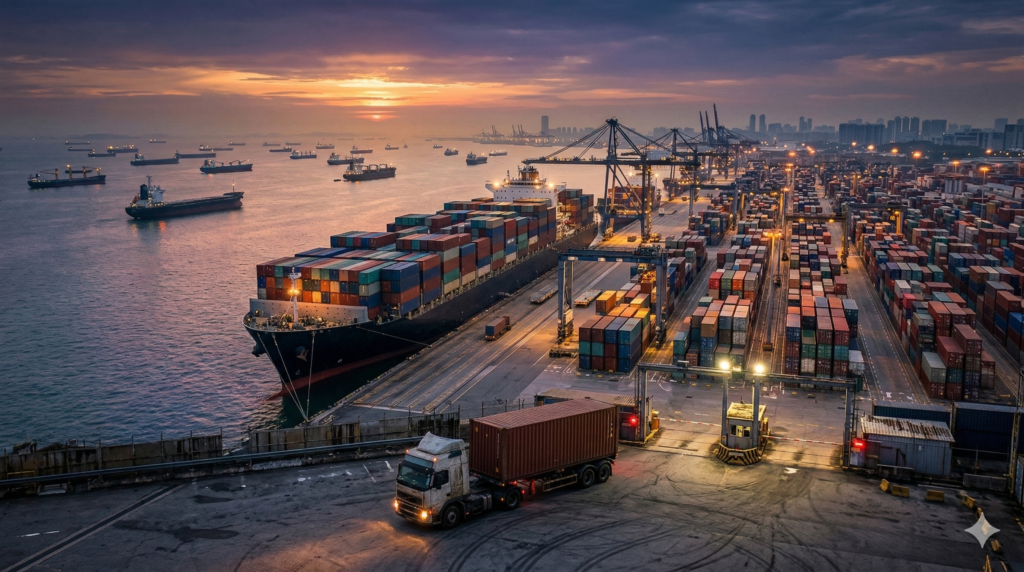
Ocean shipping is the backbone of global trade. According to the UNCTAD Review of Maritime Transport, over 80% of global trade by volume moves by sea. That number sounds staggering until you consider what it takes to move billions of units of apparel, electronics, furniture, and consumer goods from Asia to the rest of the world. There’s simply no cheaper way to do it at scale.
Cost efficiency comes with a real trade-off: speed. A standard ocean service from Asia to the US West Coast runs 12–20 days port-to-port. Asia to the East Coast, often routed through the Panama or Suez Canals, is closer to 25–35 days. And that’s just the ocean leg. Door-to-door adds time on both ends.
Two service types drive most global ocean freight:
- FCL (Full Container Load): One shipper controls the entire container, a 20-foot or 40-foot TEU, sealed and delivered. Fewer touch points, better control.
- LCL (Less than Container Load): Multiple shippers’ cargo consolidated into a single container by a freight forwarder or consolidator. More handling, but the right call when your volume doesn’t fill a box.
The major ocean carriers you’ll see in every procurement conversation: Maersk, MSC, CMA CGM, COSCO, Hapag-Lloyd, ONE, Evergreen, and ZIM. MSC and Maersk currently lead by fleet capacity.
Key Asian export ports: Shanghai, Ningbo-Zhoushan, Shenzhen, Singapore, and Busan. On the US side, Los Angeles/Long Beach handles the largest share of Trans-Pacific volume, with Savannah, New York/New Jersey, and Houston anchoring the East and Gulf Coast gateways. For current port performance data, the Bureau of Transportation Statistics publishes annual port throughput statistics worth bookmarking for any lane analysis you’re building.
The Shenzhen to Target journey — Ocean leg: A 40-foot FCL container loaded at a factory near Shenzhen gets trucked to Yantian International Container Terminal. The ocean carrier, say, Maersk or CMA CGM, issues a Bill of Lading (B/L): the legal document that simultaneously serves as a receipt for the cargo, a contract of carriage, and the title to the goods. The container’s HS Code (Harmonized System tariff classification) determines which duty rate US Customs and Border Protection will apply at arrival. Get that classification wrong, and you’re looking at delays, penalties, or both. The vessel departs Yantian and 18–22 days later arrives at the Port of Long Beach. That’s where the ocean carrier’s job ends, and everyone else’s begins.
2. Air Freight
Air freight is small in volume but large in value. Estimates consistently put air’s share of global trade value around 30–35%. Fast-moving, high-value cargo doesn’t wait three weeks on a ship.
Airport-to-airport transit from Asia to the US runs 1–3 days. Add export and import handling, and you’re still under a week door-to-door. Compare that to ocean’s 20–35-day lead times, and you understand why fashion brands, pharma companies, and consumer electronics manufacturers keep air freight in the toolkit, even when it costs 5–10x more per kilogram than ocean.
Integrated express carriers like UPS, FedEx, and DHL Express, as well as belly capacity on passenger airlines like Lufthansa, Emirates, and Korean Air, handle most of the volume. When you’re expediting a high-margin component or racing a seasonal product to market, these are your options.
For our Target shipment, the apparel in that container doesn’t qualify for air; the margin math doesn’t work at that volume. But if Target’s merchant team had a late-breaking reorder on a high-velocity item two weeks before peak? Air freight enters the conversation fast.
3. Rail
Rail is the workhorse of bulk commodity movement and long-haul intermodal in North America. Coal, grain, chemicals, and fertilizers are all moved by rail in massive quantities. For supply chain professionals, the more relevant piece is container intermodal: containers moving from ports to inland ramps via rail before the final truck leg.
The US intermodal network runs on a handful of major corridors. Containers discharged at LA/Long Beach move east on BNSF or Union Pacific rail to inland ramps in Chicago, Dallas-Fort Worth, Memphis, or Kansas City. Double-stack trains, two containers stacked vertically on specialized well cars, make the economics work at scale.
The major North American Class I railroads: BNSF, Union Pacific, CSX, Norfolk Southern, CN, and CP-KCS. Each controls a specific geographic territory, and carrier selection at the port level has real downstream implications for inland transit time and cost.
The Shenzhen to Target journey — Rail leg: After clearing US Customs at Long Beach, the container transfers to the Port of LA’s on-dock rail facility. It gets loaded onto a BNSF double-stack train headed to the Chicago Logistics Park intermodal ramp, a 2,000-mile move that takes roughly 2–3 days at rail speeds. This type of move is called an IPI (Inland Point Intermodal). The ocean carrier’s through-bill covers both the ocean leg and the inland rail move under a single contract. One document, one vendor, one price; but the shipper is now dependent on that carrier’s rail relationships and doesn’t control the inland routing. That’s a real operational trade-off worth understanding.
4. Trucking
Trucking doesn’t get the spotlight, but it’s the connective tissue of the entire system. Everything eventually moves by truck. Port to rail ramp. Rail ramp to DC. DC to store. DC to consumer. No mode comes close on flexibility.
Two product types dominate:
- FTL (Full Truckload): A single shipper’s freight fills an entire trailer, moving point-to-point without intermediate handling.
- LTL (Less-than-Truckload): Multiple shippers’ freight consolidated through a hub-and-spoke terminal network. (see our deep dive on how a freight terminal works) Slower, more handling, but the right choice when you can’t fill a trailer.
Trucking and rail compete on long corridors. Rail often wins on cost over 700–1,000+ miles. Truck wins on flexibility when you need a direct move without a ramp handoff. The BTS Freight Facts and Figures report breaks down modal share data in detail if you want the actual numbers behind those tradeoffs.
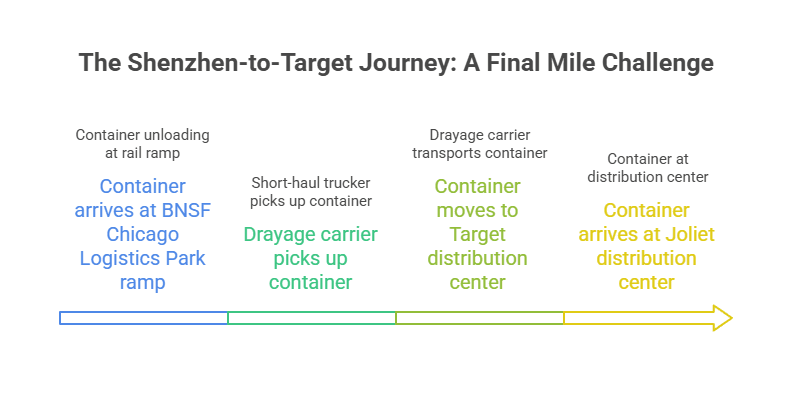
The Shenzhen-to-Target journey — Final mile: The container arrives at the BNSF Chicago Logistics Park ramp in Cicero, Illinois. From there, a drayage carrier, a short-haul specialized trucker, picks it up and moves it roughly 35 miles southwest to Target’s distribution center in Joliet. This last move takes hours, not days. But it’s where things go wrong most often: chassis shortages, driver availability, gate congestion at the ramp. The drayage leg is short and frequently the most operationally painful. That’s six legs total, from factory to CY, CY to Yantian port, vessel to Long Beach, container to rail ramp, rail to Chicago, and drayage to Joliet DC. Each handoff is a potential delay.
5. Parcel and Last Mile
Parcel is where the supply chain finally meets the consumer. Shipments under roughly 150 pounds in the US move through parcel networks, highly automated hub-and-spoke systems built to sort millions of packages daily.
Major US players: UPS, FedEx, USPS, and Amazon Logistics, with regional carriers like OnTrac filling market gaps. E-commerce has made the last-mile parcel the fastest-growing and most expensive segment of domestic logistics. Shipping cost as a percentage of revenue is a KPI that analytics teams at every major retailer are constantly trying to move.
6. Pipelines
Most logistics curricula underserve pipelines. They move crude oil, refined petroleum products, and natural gas over long distances at very low per-unit cost. The US pipeline network connects production regions like the Permian Basin to refineries and demand centers around the country. The EIA’s pipeline infrastructure data gives a good picture of just how extensive that network is.
The economics are genuinely compelling: low operating costs, energy efficiency, and no driver shortage to manage. The constraints are equally real, expensive, and slow to build, heavily regulated, geographically fixed, and limited to specific commodities.
7. Inland Waterways
Rivers and canals carry bulk cargo such as grain, coal, aggregates, and chemicals at some of the lowest per-ton-mile costs of any mode. The Mississippi and Ohio River systems move Midwestern grain south to Gulf Coast export terminals. In Europe, the Rhine, Danube, and Main-Danube Canal connect industrial regions to seaports like Rotterdam.
Slow and weather-dependent. Not a first choice for time-sensitive freight. For heavy, long-distance bulk commodities, the cost math is hard to argue with.
Modal Comparison: Choosing the Right Mode
Understanding each mode in isolation is step one. Making the actual decision is step two. Here’s how the major global supply chain transportation modes stack up across the factors that matter in practice:
| Mode | Cost (per ton-mile) | Typical Transit (US example) | Reliability | Carbon Footprint |
| Ocean | Very Low ($0.003–0.006) | 14–35 days (Asia→US) | Moderate: weather, port congestion | Very Low per unit |
| Air | Very High ($1.00–3.00+) | 1–5 days (Asia→US) | High | Very High |
| Rail / Intermodal | Low ($0.03–0.05) | 2–5 days (LA→Chicago) | Moderate: ramp congestion, weather | Low |
| Trucking (FTL) | Moderate ($0.10–0.20) | 1–4 days (regional) | High | Moderate |
| Trucking (LTL) | Higher than FTL | 2–6 days (regional) | Moderate | Moderate |
| Parcel | High (volume-dependent) | 1–5 days | High | Moderate–High |
Cost estimates are directional and vary significantly by lane, volume, and market conditions.
The right mode is always a function of the specific shipment: value density, time sensitivity, volume, and the amount of variability you can absorb in your downstream planning.
FCL vs. LCL: A Practical Decision Guide
This decision arises frequently in international procurement and logistics roles. The tradeoffs aren’t complicated once you see them side by side, but knowing when each makes sense is the real skill.
Cost
FCL is priced per container at a flat rate regardless of how full you pack it. LCL is priced per CBM (cubic meter) or by weight. The rough industry break-even sits around 12–15 CBM: below that, LCL typically wins on cost. Above it, you’re usually better off buying the box outright. At a full 40-foot container (~67 CBM), FCL almost always comes out cheaper per unit and offers better control. LCL adds consolidation and deconsolidation handling charges at both ends that eat into any per-CBM savings fast.
Transit Time
LCL is slower. Consolidation at the origin CFS (Container Freight Station) takes time. Deconsolidation at the destination takes time. Any intermediate hub handling adds more. FCL gives more predictable windows with fewer moving parts.
Cargo Risk
More touch points equal more opportunities for damage, pilferage, or misrouting. A sealed FCL container can move from the factory floor to the DC dock with minimal intermediate handling. LCL cargo gets touched more often; that’s just the nature of consolidation.
Inventory Velocity Matters Too
High-velocity SKUs that replenish frequently support FCL, since you’re filling containers regularly, and the economics work. Low-velocity, long-tail items that ship infrequently in small quantities often stay in LCL permanently. Matching shipment mode to your actual inventory profile is an underrated procurement skill.
Decision Guide
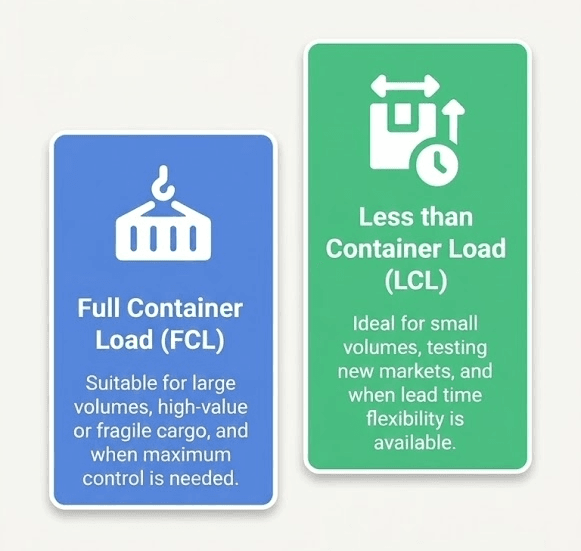
- Use FCL when: Volume is approaching or exceeding ~12–15 CBM, cargo is high-value or fragile, or you need maximum control over loading and timing.
- Use LCL when: Volume is genuinely small, you’re testing a new market or product line, or you have lead time flexibility to absorb the variability.
The Ecosystem: Who Does What
A surprising number of people entering the field learn the modes without ever learning the players. Here’s the full cast:
- Shipper: Owns or controls the goods: manufacturers, importers, and retailers. The party with something that needs to move.
- Carrier: Owns and operates transportation assets — ocean liners, trucking fleets, airlines, and railroads. Maersk is a carrier. BNSF is a carrier. UPS is a carrier.
- Marine Terminal Operator (MTO): Operates the physical port terminal — the berths, cranes, container yards, and gate systems. MTOs are separate from ocean carriers. When a vessel calls at Long Beach, the MTO handles the physical discharge and storage of containers until they’re picked up by drayage. Terminal congestion is an MTO problem as much as a carrier problem.
- Freight Broker: Connects shippers with carriers, primarily in truckload and LTL. Doesn’t own equipment; earns margin on capacity arrangements.
- 3PL (Third-Party Logistics Provider): Bundles transportation management with warehousing, fulfillment, and value-added services. Examples: XPO, Ryder, DHL Supply Chain, Geodis, GXO.
- Freight Forwarder: Specializes in international shipments; they book carrier space, handle documentation (bills of lading, air waybills, export filings), and coordinate multimodal legs.
- NVOCC (Non-Vessel Operating Common Carrier): Buys ocean capacity from carriers and resells it to shippers, issuing their own house bills of lading. Acts like a carrier from the shipper’s perspective without operating any vessels.
- Customs Broker: Handles tariff classification, duty calculation, and import entry submission to US Customs and Border Protection. In an era of shifting tariff structures and volatile trade policy, their role in avoiding delays and penalties has become more critical, not less.
The data flowing through this ecosystem is where things get genuinely messy. Purchase orders, booking confirmations, bills of lading, EDI status updates, ASNs to DCs — every player generates and consumes data, and they rarely use the same systems or standards. The World Bank Logistics Performance Index benchmarks logistics infrastructure and efficiency across countries, providing useful context for why certain trade lanes are operationally harder than others.
Visibility, ETAs, and Where the Data Breaks Down
Here’s something supply chain education doesn’t spend nearly enough time on: accurate ETAs are genuinely hard to produce, even with modern technology.
Why ETA Accuracy Is Hard
A container moving from Shanghai to a DC in Memphis touches an ocean carrier, a drayage company at origin, a US port terminal, a US drayage company, a railroad, and another drayage company at the inland ramp, at a minimum. Each party runs different systems, uses different event codes, and pushes updates at different frequencies. Some send EDI feeds every few hours. Others update manually, or not at all, on certain legs.
At-sea tracking uses AIS (Automatic Identification System) vessel data, which works reasonably well in open water. But inside a port terminal? Containers sit and move for days with no meaningful status updates. Rail has its own tracking gaps. Drayage visibility is often just a driver’s phone.
The Event Milestones You Should Be Tracking
A complete ocean shipment event chain should include all of these — in sequence, with clean timestamps:
- Gate-out at origin CY: container leaves the container yard loaded
- Vessel departure (ATD): actual time of departure from origin port
- Transshipment events (if applicable): discharge and reload at hub ports
- Vessel arrival (ATA): actual time of arrival at destination port
- Customs release: CBP clears the entry
- Terminal gate-out: container exits the port terminal
- Rail departure from origin ramp: for IPI moves
- Rail arrival at inland ramp: container available for drayage pickup
- Delivery to consignee: container arrives at the DC
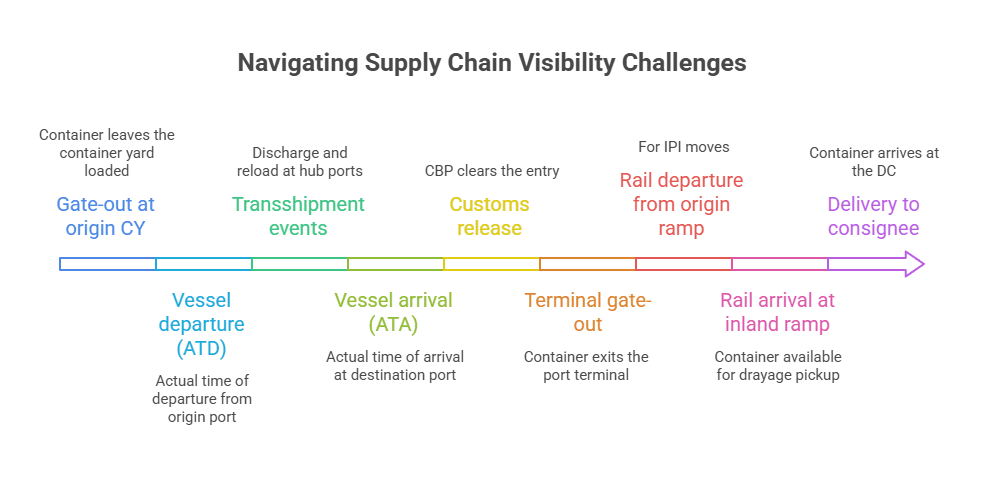
In practice, some of these arrive late. Some are missing entirely. Some reference the wrong container. It’s a data quality problem wrapped in a fragmentation problem. Both at once.
Visibility Platforms
Predictive visibility platforms like project44 and FourKites have made real progress aggregating multi-carrier, multi-mode event data into a single shipment timeline. They layer historical lane performance and vessel-schedule data on top to generate predictive ETAs, rather than just passing through whatever the carrier’s last update said. Exception alerts for late departures, customs holds, and port congestion give operations teams time to react instead of just learning about problems after the fact.
The major forwarders and ocean carriers — Maersk, MSC, DHL, and Kuehne+Nagel — have built their own tracking portals. They work for individual shipment status. They don’t solve the problem of consolidating visibility across multiple carriers and modes into a single operational view. That gap is exactly where BI starts to earn its keep.
What Upstream Variability Does to Your DC
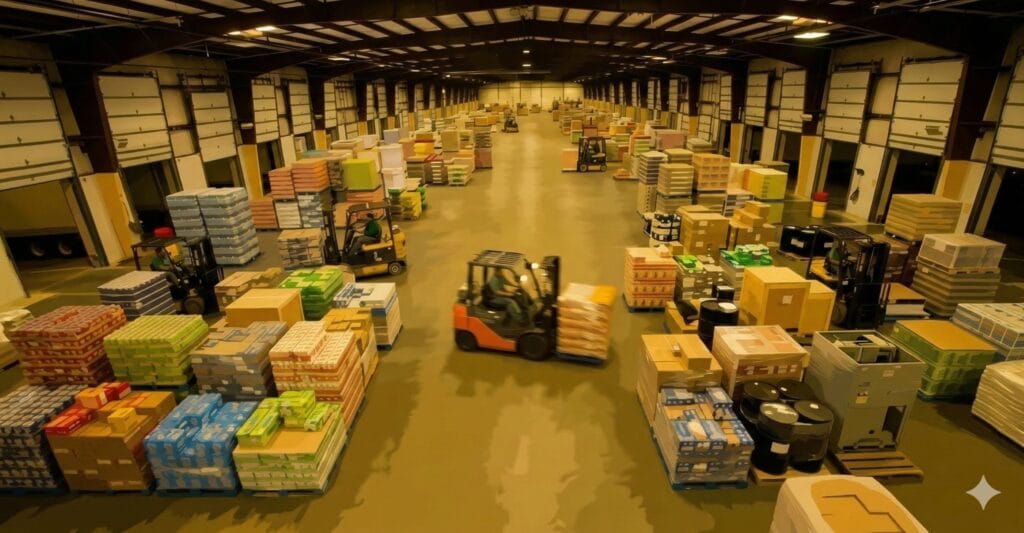
When transit time reliability is low, it shows up downstream in predictable ways. Inbound containers bunch up: three arrive the same day after a dead week, and the DC suddenly scrambles for dock doors, equipment, and labor. Safety stock buffers inflate because nobody trusts the ETA data. Labor plans built on forecasted arrivals fall apart when actual patterns look nothing like what the system predicted.
The BI plays that address this directly:
- Arrival forecasting dashboards that combine carrier ETAs with internal planning calendars to smooth inbound workload before it becomes a dock crisis
- Yard and dock utilization analytics to surface congestion patterns before they compound
- Carrier and lane scorecards tracking on-time performance, dwell times, and lead-time variability — inputs that should directly inform procurement decisions and contract negotiations
This is the connection between supply chain operations and business intelligence that most courses treat as two separate subjects. They’re not. Transportation data is the raw material for every downstream planning and optimization decision. The MIT Center for Transportation & Logistics publishes solid research on freight visibility and supply chain analytics if you want the academic grounding to back it up.
Common Questions About Global Supply Chain Transportation
What are the 7 modes of transportation in logistics?
The seven global supply chain transportation modes are ocean freight, air freight, rail, trucking (FTL and LTL), parcel/last-mile delivery, pipelines, and inland waterways. Each serves a distinct role based on cost, speed, cargo type, and geography. Most global shipments use at least two or three modes in sequence, rarely one alone.
Why is intermodal transportation used?
Intermodal combines two or more modes — typically ocean and rail, or rail and truck — moving freight in standardized containers without touching the contents at each transfer. The primary driver is cost: rail is significantly cheaper than truck over distances exceeding 700 miles. The trade-off is transit time, usually 1–3 additional days, versus direct truck.
What causes port congestion?
Port congestion results from vessel arrival bunching, labor constraints at terminals, chassis shortages, and inadequate inland rail and truck capacity to absorb discharged containers quickly. When COVID-era demand spikes hit ports in 2020–2022, all four factors hit simultaneously, leading to vessels waiting weeks to berth at Los Angeles and Long Beach and cascading delays throughout the supply chain. For a deeper dive into current bottlenecks and mitigation strategies, read my full breakdown on port congestion here.
What is a Bill of Lading?
A Bill of Lading (B/L) is the foundational document in ocean freight, serving as a receipt for cargo, a contract of carriage between the shipper and the carrier… Getting the B/L right matters because it is the key that triggers cargo release at the freight terminal.
Further Reading and Resources
Books
- The Box by Marc Levinson: The definitive history of containerization. Genuinely readable. Explains why modern global trade is even possible in the first place.
- Supply Chain Management: Strategy, Planning, and Operation by Chopra & Meindl: The textbook used in most MBA supply chain programs. Dense, but thorough.
Data and Research Sources
- UNCTAD Review of Maritime Transport: Published annually since 1968. The authoritative source for global shipping volume, fleet data, and trade lane analysis.
- BTS Freight Facts and Figures: The US government’s comprehensive freight data resource. Modal share, ton-miles, and port throughput all in one place.
- World Bank Logistics Performance Index: Benchmarks logistics infrastructure and performance across countries.
Industry Publications
- Journal of Commerce (JOC): The go-to trade publication for ocean freight, ports, and intermodal news.
- FreightWaves: Strong data-driven coverage of trucking, intermodal, and freight markets.
- Supply Chain Dive: Broader supply chain news and strategy coverage.
- Logistics Management: Solid practitioner-level content on transportation, warehousing, and technology.
Putting It Together
The global supply chain isn’t one system. It’s a series of interconnected systems, each operated by different companies, governed by different rules, running on different technology, handing off to each other at ports, rail ramps, and DC docks around the clock.
Each mode has a job:
- Ocean moves the volume.
- Air moves the value when time matters.
- Rail and intermodal provide the cost-efficient backbone for moving containers inland.
- Trucking connects everything to everywhere.
- Parcel delivers the last mile.
- Pipelines and waterways handle bulk commodities at scale.
The Trans-Pacific lane from Asia to North America is the world’s highest-volume container corridor. It underpins the consumer goods economy most of us live in. That Shenzhen-to-Target journey we tracked throughout this post? It’s not a hypothetical. It’s Tuesday. Millions of containers make some version of that trip every year, touching six or seven distinct players — each with their own systems, their own incentives, and their own definition of “on time.”
The ecosystem of players each adds specific value and introduces specific complexity. Understanding who does what and how global supply chain transportation modes connect each of them matters as much for operational execution as it does for procurement strategy.
And visibility? It’s improving. But it’s still the weak link. The gap between where a shipment actually is and where the system thinks it is remains one of the most consequential data quality problems in supply chain management. Probably will be for a while.
What’s Next in This Series
The next post moves inside North America and covers how LTL freight terminal networks actually function: hub-and-spoke operations, freight classification, dock scheduling, and what happens in the critical hours between a container leaving a rail ramp and freight arriving at your door.
After that, we’ll step inside the DC itself — inbound processing, dock scheduling, receiving operations, and how transportation data shapes everything that happens inside the four walls. (Coming soon: “How a Distribution Center Works”)
S2 BI Analytics covers the intersection of business intelligence, supply chain operations, and data-driven decision making. If this post was useful, share it with a colleague or student getting their footing in logistics.